
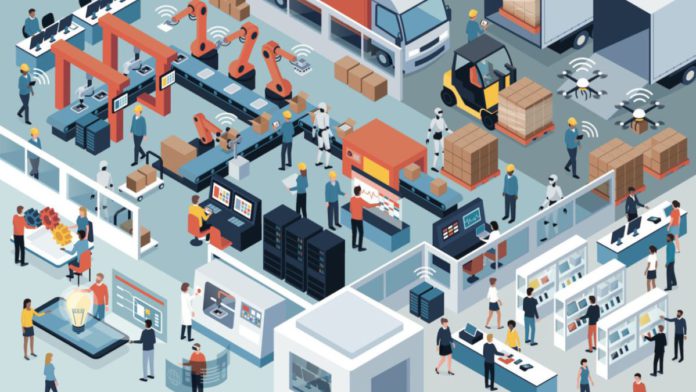
Automation in industrial engineering defines fast, reliable processing, designing, implementing, and maintaining industrial systems and products. Automation allows one to carry out complex tasks in industries by strengthening and rapidly processing them daily, as premium products need premium attention while manufacturing. It makes tasks easier with reliable and cutting-edge technology. As the demand for consistent, perfect, and safe solutions from industrial automation is rising, Industrial automation companies are coming up with innovations and state-of-art products. Here is a list of the top 10 industrial automation companies in 2022.
1. Siemens
Siemens is one of the top engineering companies based in Munich, Germany, with branch offices in over 100 countries. It is a German multinational conglomerate company and the largest industrial manufacturing company in Europe. Siemens’ objective is to create technology that will add real value to customer needs, from resource-efficient factories, resilient supply chains, and smarter buildings and grids to cleaner and more comfortable transportation. The company believes in standing for reliability, engineering quality, and innovation. It is a pioneer in infrastructure, energy solutions, automation, and the software industry. In 1867, Siemens’ founder Werner von Siemens supervised the set up of the first telegraph line between London and Calcutta, which started the partnership of Siemens in India. The company’s primary production is in the industries of infrastructure, energy, and automobile, including turbo compressors, steam turbines, high-voltage switchgear (circuit breakers, disconnectors, and gas-insulated switchgear), switchboards, and remote monitoring systems (RMS), and more. Siemens combines the real and digital worlds to empower their customers in transforming their industries and markets with digitization and IoT energy-efficient production.
2. ABB Ltd
ABB Ltd (ASEA Brown Boveri Limited) is one of the top automation companies in India that mainly focus on robotics, heavy electrical equipment, and automation technologies. The company values a more productive and sustainable future and implements the idea by transforming society and industry. ABB Ltd is a Swiss multinational corporation headquartered in Zürich, Switzerland, which has been in business since 1988. The company was established when Allmänna Svenska Elektriska Aktiebolaget (ASEA) merged with Brown Boveri & Cie. Also, ABB Ltd ranked 341st in the Fortune Global 500 list of 2018 and has been recorded as a global fortune 500 for 24 years. The production of the company is popular among various industries, including aluminum, automotive, buildings, infrastructure, cement, chemical, data centers, energy efficiency, food and beverage, OEM and panel builders, and oil and gas. To date, ABB has established offices in over 100 countries and has 105,000 employees, as reported in 2021.
3. Mitsubishi Electric
Mitsubishi Electric is a Japanese multinational electronics and electrical equipment manufacturing company established in 1920. It is a core company of the Mitsubishi group, a Japanese autonomous multinational group of companies. Japan is always ahead in the technology and development department with numerous innovative ideas, and Mitsubishi Electric reflects the same. The company has proposed and worked on many more innovations than any other top industrial automation company. The innovations of Mitsubishi include micro working robots, Ceiling-mounted horizontal-type robots, compact SCARA robots, and vertical-type and horizontal-type robots. In 2021, the company reported the financial results for fiscal of a net profit of 193.1 billion yen. Mitsubishi Electric provides reliable factory automation solutions along with a consideration of the next generation of manufacturing via its advanced engineering techniques. The company is a supplier of controllers, drive products, visualization, industrial robots, processing machine, and power monitoring products to many industrial automation companies. Additionally, Mitsubishi supplies to other automation companies like T.Vs and fighter jets.
Read more: Uniphore acquires AI-based Knowledge Automation company Colabo
4. Emerson Electric
Emerson Electric Co is an American multinational corporation based in Ferguson, Missouri, U.S., and counts in the Fortune 500 companies list. It was established by John Wesley Emerson in 1890, which services focus on electrical equipments and still stands tall among the automation companies in 2022. The company is one of the top automation manufacturers, providing automation services to empower and strengthen industries. Emerson says, “We help customers in the world’s most essential industries solve the biggest challenges of modern life.” It has around 200 production plants worldwide to provide services to industrial, commercial, and consumer markets. The automation solutions Emerson provides measurement instrumentation, solenoids & pneumatics, control & safety systems, asset management, operations & business management, and even more. Then, these automation solutions, in collaboration with automation businesses, develop complete solutions for the customers according to their industry experience. The Emerson company has two core business platforms, automation solutions, and commercial & residential solutions, which help to easily identify and confront challenges in a complex and unpredictable marketplace.
5. Rockwell Automation
Rockwell Automation is an American industrial automation company founded in 1903 and headquartered in Milwaukee, Wisconsin, U.S. The company is associated with the brands Allen-Bradley, FactoryTalk software, and LifecycleIQ services and is the biggest organization in the American market. Rockwell focuses on architecture and software segments in the production line and delivers automation solutions to customers across the globe with offices in over 100 countries. It is a fortune 500 company and reported financial results in fiscal 2021 with global sales at $7 billion. The company’s tagline is “Innovation, productivity, and sustainability starts here,” and its most advanced automation technologies provide world-class automation solutions among the top industrial automation companies. Rockwell Automation provides various products, including advanced process control, condition monitoring & I/O, distributed control systems, human-machine interface, industrial sensors, manufacturing execution systems, and more. However, the major production of the company is software segments, automation systems, and construction execution systems.
6. Honeywell Automation India Ltd
Honeywell Automation India Ltd (HAIL) is a leading integrated automation and software solution provider based in Hadapsar, Pune. It was established in 1984 as a joint venture of the Tata Group and Honeywell for manufacturing, design, and engineering facilities. HAIL is one of the leading industrial automation companies in India and is a fortune India 500 company. It has offices across India in 20 locations, including Bengaluru, Chennai, Dehradun, Delhi, Gurugram, Hyderabad, Kolkata, Madurai, Mumbai, Pune, and Vadodara. Honeywell has three state-of-art manufacturing facilities and four global technology development and innovation centers. It is a pioneer company in process automation control in the field of aerospace engineering. Additionally, Honeywell provides process, software, and building solutions with environmental and combustion controls.
7. Schneider Electric
Schneider Electric is a French multinational company that offers both software and hardware focusing on energy management and digital automation systems. It is a fortune global 500 company that was established in 1836 and based in Rueil-Malmaison, France. Along with being a top industrial automation company, it is a research company too, and the parent company of Square D, APC, and others. The company combines energy technologies, real-time automation, software, and services to provide state-of-art products to homes, buildings, data centers, infrastructure, and industries. The various products of Schneider Electric include Tricones – a safety system, DCS – EcoStruxure Foxboro, industrial communication, interface, measurement and control relays, sensor and RFID system, and so on. As the company’s mission is to be the digital partner for sustainability and efficiency, they develop connected technologies and solutions to manage energy and process in safe and reliable ways. Recently, Schneider was highlighted for its innovation with EcoStruxure, which will modernize the monitoring and management of complex and hybrid infrastructure.
Read more: Top AI chatbot companies in India
8. Yokogawa Electric
Yokogawa Electric Co. is a Japanese multinational electrical engineering and software company which is based in Tokyo, Japan, and founded in 1915. The company operates in information technologies, industrial automation, test, control, and measurement. Yokogawa has some popular and state-of-art products such as production control systems, test and measurements, pressure transmitters, oxygen analyzers, and more. Its Indian partner group, Yokogawa India Limited (YIL), was established in 1987 and stands today as a comprehensive solutions provider of enterprise technology solutions and holds an honorable position among the top industrial automation companies. YIL has built the global engineering center and manufacturing center in Bengaluru, Karnataka, and has a solid marketing and service network over India.
The three smart control systems Yokogawa have are PLC (programmable logic controller), DCS (distributed control system), and SCADA (supervisory control and data acquisition), which perform great and ease the automation process. Additionally, Yokogawa has brought some innovations in the field of industrial automation, these are synaptic business automation, OpreX, and CENTUM VP. Synaptic business automation allows enterprises to automate industrial processes and factory management. OpreX enables users to transform and digitalize their businesses. And CENTUM VP is a factory automation security architecture that consists of field control stations, a control network, and human-machine interfaces.
9. Omron Automation
Omron Automation is one of the leading industrial automation companies that creates, sells, and services integrated automation solutions. It is a Japanese electronics company based in Kyoto, Japa, and was established in 1933 by Kazuma Tateishi. Although the primary business of Omron accounts for the manufacturing and sale of automation components, equipment, and systems, Omron is widely popular for its medical devices. These medical devices include digital thermometers, blood pressure monitors, and nebulizers. In 2007, the company had a milestone when it became one of the earliest producers of automated teller machines with magnetic stripe card readers, known as the IEEE Milestone. Omron has a lot to offer with the manufacture and sale of various automated equipment and systems. Some of its products are sensors (E3NC, E32-LT11N, etc.), switches (pushbutton, indicators level switches, etc.), relays (G2RV-SR and G7SA), control components, safety components (OS32C, F3SG-SR/ PG series), and more.
10. Danahar Industrial Ltd
Danahar Industrial Ltd is an American multinational science and technology innovator corporation headquartered in Washington D.C., U.S. The company is a fortune 500 which was established in 1984, constituting an idea of discrete manufacturing businesses. Then, with the adaptation of kaizen, the Japanese philosophy of continuous improvement, Danahar was transformed into the Danahar Business System (DBS). And today, the company is committed to helping clients solve their complex challenges and improving their quality of life. Danahar provides its services and products to transform the fields of life sciences, diagnostics, and environmental and applied solutions. The company designs, manufactures and markets professional, medical, industrial, and commercial products and services innovatively. The innovations include globally helping scientists to understand chronic disease and infection by working at the molecular level and developing new therapies. The company ensures the freshness and safety of food, pharmaceuticals, and consumer goods. And to provide important tools and software for clinicians to improve diagnosis and enhance patient care.