Voice-operated virtual assistant MeetKai unveils its first lifestyle VR world named MeetKai Metaverse. The new technology allows users to experience diverse scenarios with the help of artificial intelligence and virtual reality.
In the trailer released by the company, it can be seen that users can visit various locations like museums, sports arenas, tourist destinations including beaches, and many others in the MeetKai Metaverse. Apart from visiting different areas, users can also perform activities like boxing in the newly announced MeetKai Metaverse.
It is a very cost-effective platform that offers an immersive experience to users using artificial intelligence technologies. Co-founder and CEO of MeetKai said, James Kaplan, “With our conversational AI we can enable experiences that would otherwise be unreachable or exclusive. Conversational AI is going to be the key in what comes to be known as the metaverse.”
He also mentioned that it is impossible to develop a true second place where people can experience more of the world without intelligent conversations. Users get access to various tours and get their questions answered by virtual assistants that drastically increase the quality and quantity of content in MeetKai Metaverse.
According to the company, MeetKai Metaverse will be available on Meet VR, Huawei VR, and many others by this year. United States-based artificial intelligence, virtual reality, and conversational search firm MeetKai was founded by Weili Dai and James Kaplan in 2018. The company is currently a global leader in developing artificial intelligence-based conversational assistants.
“Thanks to these unbounded virtual worlds, our physical selves can benefit from new experiences where we can see the unseen, reach the unreachable, and have access to unlimited knowledge. MeetKai’s metaverse can empower lives with great speed and efficiency,” said Co-founder and Chairwoman of MeetKai, Weili Dai.
She also mentioned that they are extremely thrilled to be the first company to provide a lifestyle VR experience using conversational AI. Interested people can register to join the waitlist for MeetKai Metaverse from its official website.
GPT-3 or Generative Pre-trained Transformer 3 is a language model developed by OpenAI in May 2020. The GPT-3 deep learning model can be used to generate human-like output in the forms of text, code, stories, poems, etc. This model was introduced as a successor to the previous language model, GPT2. GPT 3 with 175 billion trainable parameters is one of the most significant models trained compared to other language models. GPT-3 has been used in various new ways in 2021.
Language models are statistical tools that leverage deep learning to predict the following words in a sequence. The applications include machine translation, speech recognition, information retrieval, speech tagging, news article generation, question answering, etc. GPT-3 is available in eight sizes, ranging from 125M to 175B parameters. The model has become a hot topic in natural language processing, and it had ten times more trainable parameters than other models during its release. The model has been trained with 45 TB text data from sources like Wikipedia, Webtext2, Books1, Books2, and common crawl.
In this blog, you will learn about 7 ways GPT-3 was used in 2021:
CoPilot by GitHub
GitHub released Copilot in July 2021, a new programming assistant tool that can automatically generate software code. Copilot can detect a snippet of code and complete the rest automatically. Copilot can understand various programming languages and can also help with component integration. It can also check an application’s reliability by analyzing code with an open-source testing module rather than adding it to the code base.
Copilot uses OpenAI’s Codex, an artificial intelligence model based on GPT-3. The Codex has been trained on billions of lines of open source code from GitHub along the model to harness common code patterns for generating code suggestions. It is initially available as an open-source visual studio code editor for local and cloud use. Microsoft and OpenAI plan to make it available for other enterprises to incorporate this feature into their products.
iNFTs
The tokenized form of Sophia, the world’s most renowned humanoid robot, will be available for auction on Binance as a part of the initial game offering (IGO) set. A total of 100 intelligent non-fungible tokens or iNFTs will be auctioned under the name: The transmedia universe of Sofia beingAI. The Sophia BeingAI iNFT used GPT-3 to bring 100 tokens of Sofia beingAI to life for the metaverse. These intelligent NFTs can engage with humans in gamified atmospheres. beingAI teamed up with Alethea AI, an iNFT production company that employs GPT-3 to generate intelligent NFTs.
Power Fx Formulas by Microsoft
Microsoft announced that it is integrating OpenAI’s GPT 3 into various applications, such as generating Power Fx formulas. Power Apps Studio is a low code platform for people without coding knowledge to build applications. The Power Apps paired with GPT-3 will be able to translate spoken text into code in the newly launched Power Fx language, the low code aspects of a tool into a no-code experience. This will enable the Power Fx tool to translate natural language into a formula.
Microsoft has also launched Azure OpenAI Service. Now, OpenAI machine learning models, including GPT-3, can be used on the Azure platform. However, currently, its invitation only and for customers who are planning to implement responsible principles and strategies for the AI technology.
Candy Shop Slaughter
Candy shop slaughter is a video game developed by the Fractl gaming group and commissioned by OnlineRoulette.com. The agency used GPT-3 to create a hero character and surveyed 1000 gamers to find whether they were willing to play the game. They also questioned gamers about the originality of the game and their willingness to pay for it.
The GPT-3 model also created the fictional game’s arcade, story, and multiplayer mode. AI created this Freddy Skittle, the game’s main character and Ted’s best friend. There were two modes: story mode, where the game utilizes a karma system to accumulate experience points for players, and arcade mode, where the blood and guts of the 3D fighting battle were transformed into treats and candy.
Language models by OpenAI
One of the ways OpenAI used the GPT-3 in 2021 was fine-tuning the deep learning model using a text-based web browser to improve the factual accuracy of GPT-3 language models. This browser allowed the GPT-3 language model to research similar to humans by submitting queries with keywords, following links, and scrolling result pages to answer open-ended questions. To test responses, TruthfulAQ, a data set of short-form questions, was used to test whether models fell prey to common misconceptions. Responses of models were recorded on truthfulness and informativeness. The new model outperformed GPT-3 but lagged behind human performance because models failed to distinguish between reliable and unreliable sources.
Emails and messages by Flowrite
Flowrite can turn a few instructions into a fully-fledged email or message. Where Grammarly helps improve an existing piece of writing by suggesting tweaks to syntax, style, and grammar, Flowrite can help you write interesting emails. The application uses GPT-3 as its core tech and is focused firmly on professional communication. From scheduling meetings to providing feedback and closing new business, Flowrite saves time by writing emails and professional messages.
Phishing emails
Singapore state technology agency conducted a study that sent phishing emails generated by GPT-3 and other AI technologies. The study found that most employees fell for phishing emails written by artificial intelligence systems. The AI models focused on personality analysis and individual reaction tendencies. Eugene Lin, a cybersecurity specialist, stated that they require millions of dollars to train models, but it costs a couple of cents once you put it on AI-as-a-Service.
Conclusion
In this blog, you will learn about 7 interesting ways GPT-3 was used in 2021. GPT-3 has been made available by OpenAI, where everyone can request access for research and development. GPT-3 has also been used for writing blogs, recreating works of perished poets, and generating quotes. Companies like GitHub and Microsoft Azure are also using it to improve their programming platforms by adding natural language.
The unmatched capabilities and versatility of artificial intelligence solutions convince not just industries but also governments to adopt and deploy them in various fields. Like governments of many countries, the Indian Government has also taken many initiatives to develop and deploy artificial intelligence technologies. Ranging from the production of semiconductors to traffic safety, the Central and State Governments of India have taken various steps to increase the adoption rate of AI solutions. This article will list the top AI initiatives of the Central and State Government of India in 2021.
1. Mission Revv for AI Startups
The Government of Telangana recently launched its new initiative named ‘Mission Revv‘ to support artificial intelligence startups. It is one of the most significant AI adoption initiatives taken by the State Government in 2021. The Government of Telangana collaborated with NASSCOM to develop the new program. With Mission Revv, the Telangana government aims to make the state a global hub for artificial intelligence. It is an accelerator program, which allows AI startups to work alongside the Government to develop innovative solutions for commonly faced business challenges. The Government will also aid AI startups in expanding their business operations under the Mission Revv accelerator program. Since its commencement0 in July 2021, the program has already selected over 42 AI startups to help them scale up their businesses. Selectors of the accelerator program diligently scrutinized the use cases of all the applicants to decide the selected 42 AI startups. “NASSCOM’s close partnership with Telangana will provide significant impetus for startups and their aspirations to become the artificial intelligence garage for the world,” said Debjani Ghosh, NASSCOM President.
2. AI-powered Face Recognition system for Pensioners
The Indian Government recently announced the launch of a new artificial intelligence-enabled facial recognition system to provide certificates of life. The system is expected to considerably help senior citizens of the country to avail their pensions. It is one of the top AI adoptions of the Central Government in 2021. The Government of India claims that the AAI system will also improve the ease of living of older people. Users need to have a smartphone with a camera and a stable internet connection to enjoy the services of the AI-powered facial recognition system. According to PTI, “The identity of a pensioner or family pensioner will be determined using a face recognition technique under this capability. Any Android-based smartphone will be able to submit a Life Certificate utilizing this technology.” The new AI system will help over 68 lakh retired government employees and workers under the Employee Provident Fund Organization and state governments. This one-of-a-kind AI facial recognition system has been developed by the Ministry of Electronics and Information Technology and the Unique Identification Authority of India. Interested people can visit here or download the AdhaarFace ID smartphone application to register.
3. AI to reduce Road Accidents by 2024
Union Minister Nitin Gadkari reveals the Indian Government’s plans to reduce road accidents by over 50% before 2024. Gadkari mentioned that road safety has now become the Indian Government’s top priority, and they are all set to use artificial intelligence solutions to make roads safer for travelers. India records over 150,000 deaths every year due to road accidents, and the government initiative will drastically reduce the casualties. The AI-powered system will be used to monitor lane discipline on national highways, overspeeding, driver fatigue, and many more related tasks. The advanced technology will also feature capabilities for post-accident forensic investigation and a vehicle collision system to help authorities minimize the chances of any mishap on highways. Nitin Gadkari said, “AI can be used to combine data from all applicable sources above with data used to make appropriate changes at the policy level. The private sector has expanded cooperation and can combine it.”
4. MeitY and SSB to use AI technologies for border security
India’s Ministry of Electronics and Information Technology, along with Sashastra Seema Bal, announces that they intend to use AI technologies to identify suspicious persons and vehicles near the borders. This development will help in providing higher security in the border regions. The ministry has called out for AI startups to develop low-cost border security solutions that the Indian Army can adopt. According to officials, they plan to use AI-powered sensors and other related electronic equipment to develop a low-cost AI border maintenance system. The participating AI startups will be expected to build trackers, drones, tools for geospatial mapping of vulnerable areas, and more such tools. SSB plans to use a database of collected information, including audios, videos, texts, and images, to identify suspicious people and vehicles using artificial intelligence-based sensors.
5. Telangana to use AI for checking the quality of Crops
The IT department of the Telangana government announced its plans to launch a new artificial intelligence-powered system, which will be used to check the quality of crops. The AI system will help officials to increase and maintain quality standards of yields across the state of Telangana. Initially, the Government plans to deploy the AI-powered system in three procurement facilities in Narayanpet and Kamareddy. The newly developed AI quality checking system will be used to check the quality, grade, moisture in crops like Bengal Gram, Red Gram, and Paddy. The system will also generate detailed reports regarding the gains after thorough analysis to help officials check their quality. High-quality 360° images of grains are used by the AI system to identify the moisture content, size, color, immatureness, and presence of any foreign matter in grains. In the future, developers of the AI quality checking system will add more capabilities, allowing the system to check the quality of fruits and vegetables.
6. AI-powered Surveillance Cameras in Kerala
The Kerala government recently announced the launch of the first batch of a hundred AI-powered surveillance cameras under the Safe Kerala initiative. The artificial intelligence-enabled cameras will be installed at different locations in the state to track and monitor traffic. With the new AI cameras, the police department will be able to quickly identify traffic norm violators and send them e-challan. The system will drastically reduce the workload of police and would allow them to focus on more important matters of the state. According to the Kerala government, over 700 such cameras will be installed phase-wise, and the total budget for this initiative is around INR 235 crore. The Safe Kerala initiative was initially launched in 2019 by the Chief Minister of Kerala Pinarayi Vijayan. Since its launch, various schemes have been launched to make Kerala safer.
7. NASSCOM and Govt. of Andhra Pradesh launched the Center of Excellence for IoT and AI
The National Association of Software and Companies (NASSCOM) launched its new Center of Excellence for IoT and AI located in the Andhra University campus, Vishakapatnam. NASSCOM collaborated with the Ministry of Electronics and Information Technology and the Government of Andhra Pradesh to establish the COE. The newly launched center of excellence will develop world-class artificial intelligence solutions to tackle real-world challenges and also promote entrepreneurship by offering incubation facilities to technology startups in the region. The Center of Excellence for IoT and AI was inaugurated by Union Ministers Rajeev Chandrasekhar, Mekapati Goutham Reddy, and several other government officials.
8. AI to monitor Traffic Norm Violators
Kolkata Police also plans to install numerous AI-powered CCTV camera systems named Integrated Traffic Enforcement Management System (ITeMS) at multiple locations to monitor traffic norms violators. Video footage collected from these cameras will be fed to an AI-powered video analysis software to determine individuals who have violated traffic norms. The system will automatically send e-challans to violators via SMS. It is believed that the new AI system will help traffic police effectively carry out their day-to-day duties without worrying about traffic violations. According to the plan, the AI video analysis system will eventually analyze footage of more than 2500 cameras to recognize helmet-less bike riders, red light hopping, rash driving, parking violations, and many more. The system will be directly connected to the RTO to further smoothen the process of sending e-challans to violators.
Hyper-scale computing developing company Avalanche Computing announces to launch their new highly capable low-code artificial intelligence tool at CES 2022. The event is planned to commence on 5th January in Las Vegas, the United States.
The event will host companies from various parts of the world to showcase their technologies to a larger audience. The company is all set to unveil its newly developed artificial intelligence tool at the TTA Pavilion at Booth 61423 and 61837 in Sands Hall G, Eureka Park, Las Vegas Convention Center.
The new Software as a Service named hAIsten AI can drastically reduce the time involved in developing full-fledged artificial intelligence models. Co-founder and CEO of Avalanche Computing, Jay Chen, said, “We are really excited to share hAIsten AI with CES 2022 participants and believe this tool will revolutionize how data scientists train their algorithms, creating more parity in the AI development space.”
A typical AI model development involves numerous time-consuming and complex tasks, which are also very expensive. Avalanche Computing’s hAIsten AI solution will considerably help developers and engineers quickly build AI models by reducing the time from an average of a year to just a matter of months.
The solution leverages multiple GPUs to speed up the model development process. The solution provides a user dashboard that can be used to motor the status of AI models in real-time, helping users to better manage their models. Taiwan-based deep learning tools developing firm Avalanche Computing was founded by Jason Huang, Jay Chen in 2018.
The company specializes in developing hyper-scale computing solutions primarily for the artificial intelligence industry. “Our technology enables teams to bring their new products to the market faster, supporting their competitiveness in the fast-evolving AI arena,” said Co-founder Jason Huang.
Trading software developing company for the finance industry Vantagepoint AI receives an award for leading AI-powered trading software provider in 2022. Corporate Vision Magazine’s Excellence award bestowed Vantagepoint AI with this remarkable award, making an excellent start for the company in the new year.
Vantagepoint AI’s solution allows independent traders to enjoy various benefits of artificial intelligence-powered features from their PCs, aiding them in trading. The company has gained a loyal customer base by providing unmatched forecasts and trading predictions that have helped hundreds of independent traders.
President of Vantagepoint AI, Lane Mendelsohn, said, “Our greatest reward is hearing from traders daily about how our software and our dedication to customer care are changing their lives. It’s humbling to know that other companies might emulate our formula.”
He further added that they are extremely honored to be recognized by the Corporate Vision Magazine for being a company that can inspire others. Corporate Vision Magazine is one of the most popular and acclaimed global business magazines that focuses on better business practices and covers the latest trends in products, services, and innovations.
Tampa Bay-based software developer Vantagepoint AI is a family-owned business founded by Louis B.Mendelsohn in 1979. The company also provides free live online sessions to teach beginners how to use artificial intelligence in trading. Interested candidates can easily enroll themselves for free live sessions from the official website of Vantagepoint AI.
The company’s platform can predict trends in Stocks, Futures, Forex, Cryptocurrencies, and ETFs using its patented neural network process. It is a highly accurate platform with an accuracy rate of over 87.4% and has a customer base spread across more than 160 countries globally.
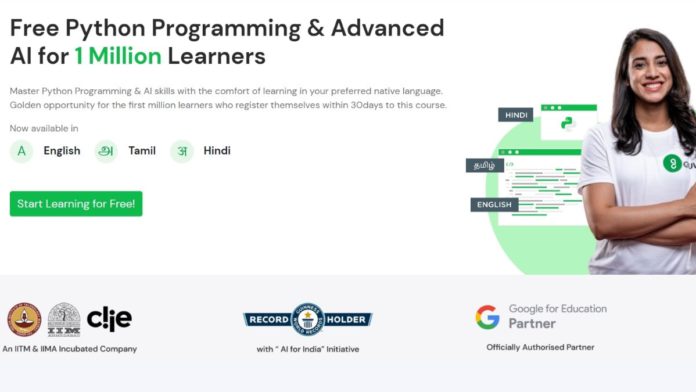
IIT Madras and IIM Ahmedabad incubated startup GUVI announces that it has partnered with the All India Council of Technical Education (AICTE) to offer free Python and artificial intelligence courses to students.
The new program will after more than one million learners from the disadvantaged sections of the Indian society and help them gain the required skills to kick start their careers in the technology industry.
The initiative named NEAT 3.0 was recently launched by the education minister of India, Dharmendra Pradhan. GUVI officials and the startup founders were also present at the launching ceremony of NEAT 3.0 held in New Delhi.
A significant highlight of the newly launched free course for Python and artificial intelligence is that it would offer high-end training to learners in multiple regional languages of the country, including Tamil, Hindi, Telugu, and many more.
“I appreciate GUVI for joining with AICTE to lead this initiative for empowering the socially and economically disadvantaged youth through its online and vernacular approach in tech-learning. India needs enormous employable youth propelled through such initiatives of AICTE,” said education minister Dharmendra Pradhan.
He also mentioned that he is incredibly proud to witness that Indian startups are becoming global leaders in the 21st century. According to the ground plan, AICTE will distribute free edTech coupons to learners having an annual family income of less than 8 lakh via the NEAT portal and GUVI’s official website.
Chennai-based technical learning provider GUVI was founded by Arun Prakash, Bala Murugan, and Sridevi Arunprakash in 2014. The startup specializes in providing educational videos courses for Python, Android, C++, Java, Big Data, MongoDB, and various others in multiple regional languages, expanding its reach to previously untapped regions of the country.
Co-founder and CEO of GUVI, Arun Prakash, said, “Our aim to bestow the best employable skills on our nation’s youth coincides with the aims of NEAT. Python Programming and AI skills offered through this collaboration will be of strong support for the deserving students, helping them to grow in their career.”
Touch-based human interface developer for devices like laptops and smartphones Synaptics reveals that Askey uses Synaptics’ Multimedia VS680 SoC to carry out various artificial intelligence-related functions in Askey’s new OmniEdge Smart Signage system.
The SoC developed by Synaptics allows Askey to add multiple interactive and personalization features to their solution. The OmniEdge Smart Signage uses the highly capable neural processing unit of Synaptics’ VS680 SoC and couples it with a high-quality dual-camera system to provide an immersive, intuitive and immersive experience.
Askey’s developers effectively tapped the capabilities of the Multimedia VS680 SoC’s Android SDK and SyNAP to come up with several high-end and robust biometric security, augmented reality, demographic identification, video conferencing, and many more.
CEO of Askey, Robert Lin, said, “With those requirements in mind, we evaluated a number of competitive options and selected Synaptics’ VS680 because it delivers the best combination of performance and features to meet our current and future needs.”
He further added that the VS680 camera and AI capabilities allowed them to provide field-upgradable products, which are very cost-effective to design and develop. According to Askey, its OmniEdge Smart Signage solution is rapidly driving the market towards a change, which needs a highly-scalable future-proof platform.
United States-based technology company Synaptics was founded by Carver Mead and Federico Faggin in 1986. The firm specializes in developing solutions that can be used to optimize user experience in various industries, including automobiles, PC, smartphones, and many more. To date, Synaptics has successfully acquired five companies, including DisplayLink, Validity Sensors, DSP Group, and others, which have allowed the enterprise to provide top-notch solutions to its customers.
Senior Vice President and General Manager of Synaptics, Craig Stein, said, “We are very excited that Askey has relied upon the capabilities, flexibility, and low-power performance of our VS680 solution to help them tap the full potential of this experience within the OmniEdge platform.”
The artificial intelligence industry is booming at an exponential pace globally. Therefore, a greater demand can be seen for specialized workers in the AI and data science domain. According to a recent report, job opportunities in the AI industry have witnessed a growth of more than 75% over the last four years. Enterprises across the world are looking forward to hiring skilled employees to carry out their business operations. Although the AI industry is expanding, there is still a lack of quality educational programs in India that teaches learners essential skills and impart practical knowledge in the artificial intelligence sector. It has become crucial for educational institutions to provide adequate training courses to help learners kick start their careers in the artificial intelligence sector and meet the global demand. Many renowned Indian Institutes have addressed this necessity and have begun offering several AI programs, including undergraduate, postgraduate, diploma, and certification courses. This article will list the top AI courses and programs in India available in 2021 by IITs, NITs, and IISc.
The article intends to provide descriptions of all the top available courses and not rank them to help learners choose the best for them according to their interests.
B.Tech in Data Science and Artificial Intelligence | IIT Guwahati
The B.Tech program in Data Science and Artificial Intelligence is offered by the Mehta Family School of Data Science and Artificial Intelligence in the Indian Institute of Technology Guwahati. This course helps learners in entering various industries such as data architecture, data engineering, data analysis, and many others. The curriculum includes multiple modules related to programming, AI, data science, mathematics, robotics, and computer science. According to the director of IIT Guwahati, the graduates of this course would play a vital role in industries like technology, business, healthcare, disaster management, and several more.
Advanced Program in Artificial Intelligence-powered marketing | IIM Calcutta
The Indian Institute of Management Calcutta offers the Advanced Program in Artificial Intelligence-powered marketing course. The course will help learners open doors to build careers primarily in multiple sectors by providing them with the required training in making AI-powered marketing decisions. Aspiring CXOs can readily opt for this program to enter various industries, including banking, retail, finance, and healthcare industries. It is a part-time six-month course in which the sessions will be conducted online. However, some course portions will be taught in person at IIM Calcutta. Graduates with three years of hands-on experience and postgraduates with two years of experience are eligible for this AI program. Interested candidates can start the application process from the official website of IIM Calcutta.
M.Tech in Artificial Intelligence | IISc
The Indian Institute of Science Bangalore offers a master’s course in artificial intelligence. It is a two-year degree program provided by IISc’s division of electrical, electronics, and computer science (EECS). According to the institute, the course aims to train professionals that would help in filling the availability gap of highly skilled artificial intelligence scientists and engineers. Learners will be provided with best-in-class training related to the core concepts and practical implementation of artificial intelligence solutions. Candidates are shortlisted based on their GATE scores, and then the selected candidates must appear for a written examination and qualify for entrance in the M.Tech program in AI. The course curriculum includes a one-year research and development project that would help learners carry out their duties in companies after completing the course. interested candidates can apply by visiting the official website of IISc.
Certificate Program in Machine Learning and AI using Python | IIT Bombay
The certificate program in machine learning and AI using Python is offered by the Indian Institute of Technology Bombay. It is a six-month course in which the sessions will be conducted virtually for three hours per week. The course aims to upskill learners in the world’s most in-demand programming language for artificial intelligence and machine learning automation. Graduates and diploma holders from any background with a minimum of one year of experience are eligible to apply for the AI program. The course has been priced at ₹1,25,000 excluding GST. Experts from IIT Bombay will conduct sessions during the course and offer real-world case studies to help learners gain relevant knowledge. Learners will also get to participate in various peer-to-peer learning and networking that would help them build their careers. Upon completion, learners will be provided with a certificate who have a minimum of 80% attendance.
M.Tech in Machine Learning and Data Science | IIT Delhi
The Indian Institute of Technology Delhi is all set to offer its new M.Tech degree program in Machine Learning and Data Science at its School of Artificial Intelligence from 2022. The name of the course is M.Tech in Machine Intelligence and Data Science (MINDS) and will focus on teaching learners the fundamental concepts of artificial intelligence. Learners will get hands-on practical experience that would help them gain the desired skill set that the global industry currently demands. The first batch of the post-graduation course will begin in July 2022. Students will get to learn from 40 faculties from industry-leading research centers of Microsoft, Google, IBM, and many more. The curriculum will include subjects like deep learning, natural language processing, data mining, computer vision, mathematics, and several others.
6. Bachelor’s of Science in Statistics and Data Science | IIT Kanpur
The Indian Institute of Technology Kanpur has started offering two new programs, namely, a four-year-long Bachelor’s of Science and a five-year Bachelor’s cum Master’s of Science in Statistics and Data Science. The admission for this AI course will be based on JEE rankings of students. It is one of the best available programs for learners who are more interested in studying and analyzing data. The course’s curriculum includes subjects like fundamentals of statistics, mathematics, data science, and many more. Learners will be able to gain industry-specific skills that the global market demands, which would help them build careers in the data science industry.
7. Post Baccalaureates in AI and Data Science | IIT Madras
The Indian Institute of Technology Madras is now offering post baccalaureate fellowship in various fields related to artificial intelligence and data science. The Robert Bosch Centre for Data Science and Artificial Intelligence (RBCDSAI) established in the campus of IIT Madras is offering this 1-2 year course in artificial intelligence. The Robert Bosch Centre for Data Science and Artificial Intelligence was founded in 2017, and it started offering this post baccalaureate fellowship from 2019. It is a highly acclaimed institution, which offers ample exposure and hands-on industry experience to students to kick start their careers in the data science and artificial intelligence industry. The institute has also increased the intake capacity to 15, which reflects the popularity of the program. Graduates below 27 years of age can readily apply for this course offered by IIT Madras. After shortlisting, candidates must appear for an interview round to secure a seat for the course.
Speech recognition software firm Fluent.ai partners with a leading global provider of acoustic microphones and speakers Knowles to reveal the future of true wireless stereo voice control systems at CES 2022.
The event is scheduled for 5th January in Las Vegas, the United States, in which companies from all over the world are set to showcase their technological innovations. Jointly, the companies will develop an offline application-free artificial intelligence-powered voice control system for True Wireless Stereo earphones and other related products.
CEO of Fluent.ai, Probal Lala, said, “TWS use cases fit Fluent’s unmatched advantages perfectly as hearables are intended for consumer use anytime and anywhere. Our embedded technology enables users of any language or accent to use their earbuds off the grid and in noisy environments without needing to worry about noise levels, battery life, or privacy.”
He further added that the new technology would allow them to provide multilingual command support to offer their customers a better user experience. The companies plan to integrate Fluent.ai’s small-footprint AI software with Knowles IA8201 to enable unmatched voice command capabilities for TWS earphones and other hearable devices.
Till now, achieving this level of accuracy in voice commands for TWS earphones has been a challenge due to the compute limitations of Bluetooth microchips and the requirement of low power in TWS.
Canada-based speech understanding and intent recognition solutions developer Fluent.ai was founded by Vikrant Tomar in 2015. The company specializes in developing speech recognition systems that use machine learning models which consider various factors, including context, behavior, and speech in multiple languages, to offer the best possible experience to users. Fluent.ai has raised over $4 million to date from investors like BDC ICE Funds, Generation Ventures, BDC Venture Capital, and many others.
On December 27th, at the event in Paris, YetAi announced that the protocol is bringing artificial intelligence (AI) NFTs to the Solana ecosystem.
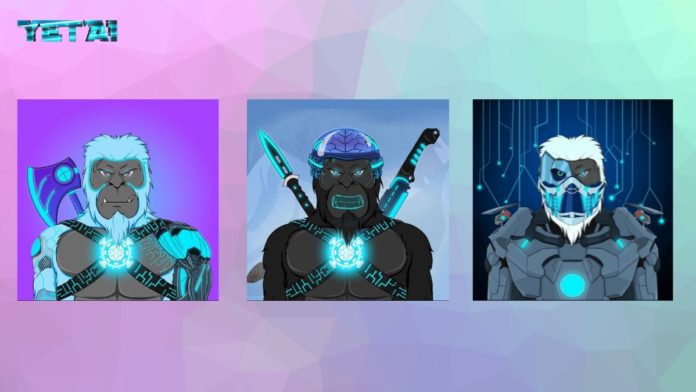
YetAi is an NFT collection of AI Yetis that claims to be the first NFT initiative to apply AI to blockchain and Web3 technology. The collection’s backstory narrates that the Yeti tribe reincarnated as YetAi’s after a member of the tribe encountered the Visai, an Artificial Intelligence that irrevocably altered the Ketra tundra metaverse.
YetAi intends to provide a variety of services to community members and holders through this great initiative. The YetAi collection will consist of 8,888 Yeti NFTs created totally by AI and will feature over 90 traits. Holders and community members will have access to a variety of utilities thanks to the protocol. Exclusive access to special events, seminars, and community conferences is one such benefit. The NFTS miners will also get 70% of royalties on future NFT sales.
In the coldest & most threatening region in Metaverse called Ketra tundra lived the Yetis for ages. YetAi, together with SOLANA Blockchain, gives you the first 100% AI-generated NFT's of more than 90 traits.
In addition, the protocol provides an AI trading bot that buys and sells bitcoins on behalf of its subscribers. This eliminates the need for consumers to learn and execute sophisticated trading methods, by relying on a bot to do it. The protocol’s token will be released in the first quarter of 2022. The token will be used in the Ketra Tundra metaverse as both a utility and a governance token.
For now, the pre-sales and whitelist dates are yet to be announced. Meanwhile, YetAi shares that 70% of NFT revenues should go to the creator royalties. There are other long-term plans in place, including the production of merchandise and goodies.
Besides, there will be private events in the future to which holders will be invited and will be provided with all expenses paid accommodations. Seven holders will be present at one event that will be hosted in Singapore. The holders will also receive their Metaverse territory. In addition, a private and exclusive YetAI App will be released.
NFTs are quickly becoming one of the hottest hits in the crypto world and the race into launching interesting NFTs into the marketplace is heating up. The NFTs in early 2021 generally concentrated on basic features like ownership as well as the development of the NFT marketplace, a foundation for the future of Blockchain.
However, as the industry matures, NFTs’ value proposition should shift from static photos to more dynamic and intelligent collectibles including iNFTs and NFTs with embedded AI. It is safe to predict that AI will play a major role in the future generation of NFTs. using artificial intelligence technologies like Natural language understanding (NLU), computer vision, NFT creators can also accelerate the Generative AI industry too.
Tectona, Israel’s premier public blockchain technology startup, has built a platform that allows anybody to use a powerful AI to create unique art for minting as NFTs. Last December, the company stated that it will debut a user-generated NFT collection in the Metaverse under the name ‘The Bored Company.’ Even Alethea AI, a startup backed by entrepreneur and Dallas Mavericks owner Mark Cuban, is encasing avatars with AI that animates them and provides them with communication skillsets. Known as iNFTs, these avatars will be similar to chatbots we are already using in the 2D internet world!