Full-stack autonomous driving solutions developing company Pony.ai receives its clearance for paid autonomous robotaxi service in Beijing, China. The recent approval will allow Pony.ai to provide its self-driving taxi service to people in the Beijing Intelligent Networked Vehicle Policy Pilot Zone located in the southern part of the capital city.
Pony.ai will now be able to charge relevant fees from passengers to access the autonomous driving taxis. This new development will allow the company to deploy up to 100 autonomous taxis in the designated locality. This is a step forward towards the company’s goal to commercialize robotaxis at a global level.
CEO and Co-founder of Pony.ai, James Peng, said, “Supportive policies, development of safe technology, and public acceptance are the keys to accelerating commercialization of the autonomous driving industry, and Pony.ai has conducted abundant testing of the application scenarios and product forms of autonomous driving over the past five years.”
He further added that this approval marks the next step in self-driving car development as the new policy will allow Pony.ai to test and validate its commercialization model. Prior to this policy, Pony.ai’s PonyPilot+ robotaxi service was operational free of cost for passengers to travel in a restricted area of 60km2.
PonyPilot+ uses a smartphone application and an in-car solution named PonyHi to provide a safe, comfortable, and hassle-free experience to its passengers. CTO and Co-founder of Pony.ai, Tiancheng Lou, said, “Today, our autonomous driving technology has advanced beyond conventional driving scenarios, demonstrating the technological capability to handle more complex driving scenarios and at a larger scale.”
Along with Pony.ai, Chinese technology group Baidu also received approval to launch paid autonomous robotaxis in the same locality. According to Baidu, this will be the company’s Apollo Go service’s first-ever commercial deployment.
The forecasting report of a tech research and consultancy company called Gartner states that global artificial intelligence software revenue will be $62.5 billion in 2022.
As compared to the current year of 2021, there is a considerable increase in revenue by 21.3 percent. This number represents an increase of more than a fifth compared to revenue figures from 2021.
In 2022, businesses worldwide are all set to spend more on artificial intelligence-powered software services than ever before. The top five use cases of AI service spendings in 2022 will be on knowledge management, virtual assistance, autonomous vehicles, digital workspace, and crowdsourced data.
Gartner said that the successful business outcomes using the five major use cases would depend on selecting the use cases carefully. Each use case could provide significant value while being scalable to reduce risk and would be vital for demonstrating the importance of AI investment to stakeholders.
The Gartner report states that worldwide enterprises are continuously demonstrating a strong interest in AI-based services because of the enormous revenue generation. Nearly 48% of Chief Information Officers (CIO) who responded to the previous surveys of Gartner said that major enterprises present worldwide have planned to deploy AI and machine learning technologies within the next 12 months.
It is evident that advances in AI maturity will naturally increase AI software revenue through increased spending across enterprises globally. In the official press report, Alys Woodward, senior research director at Gartner said that “The AI software market is picking up speed, but its long-term trajectory will depend on enterprises advancing their AI maturity.”
The researchers at the University of California San Diego School of Medicine have taken a significant leap forward in understanding human cells. Their pilot study combines biochemistry, microscopy, and artificial intelligence in a technique known as a multi-scale integrated cell, or MuSIC. The study uses deep learning to map the human cell and it found about 70 components in a human kidney cell line, half of which have never been seen before. In all the components of a human kidney cell line, researchers determined an unfamiliar structure to be a new complex of proteins that binds RNA.
Scientists have believed that there is more to human cells than mitochondria, endoplasmic reticulum, and nucleus. The large portion that has been unknown to humans for research can now be studied. The MuSIC research, powered by artificial intelligence, finally provides a way to look deeper.
Complex found through MuSIC enables the translation of genes to proteins and also determines which is activated at which times. The cells’ proteins are studied using one of the two techniques: biophysical association and microscope imaging. Microscope imaging tags various fluorescent colors to proteins of interest and allows researchers to track the movements and associations across the field of view. For biophysical associations, researchers use an antibody specific to a protein to remove it from the cell and see what is attached to it.
MuSIC uses deep learning technology to map the interior work of the cell directly from cellular microscopic images. Although microscopes allowed researchers to look down the size of a single micron, smaller elements such as protein complexes or individual proteins are not visible through it. Biochemistry techniques allow scientists to look at things that are one billionth of a meter or 1000 microns but the gap between microns and nanometers remains.
The researchers at the University of California San Diego School of Medicine were able to bridge the gap from nanometre to micron-scale using artificial intelligence. To do so, they collected data from multiple sources and asked the system to assemble the data into a cell model.
Researchers trained MuSIC to look at all the data for constructing a model of the cell. However, the system cannot map cell content to specific locations since their locations are not necessarily fixed. One of the most significant benefits of this research is that scientists will better understand the molecular basis of various diseases by comparing the innermost structures of healthy and diseased cells.
World-leading automation solutions providing company Standard AI to drive the future of autonomous checkout systems at retail stores in various regions. Recently, the company successfully completed its acquisition of United Kingdom-based computer vision firm ThirdEye Labs.
However, no information was provided by company officials regarding the valuation of this acquisition deal. With this new acquisition, Standard AI will use the expertise of ThirdEye Labs in computer vision to further improve its autonomous retail checkout system.
Additionally, former team member of Tesla and Lyft, Sameer Qureshi, will join Standard AI as its first Vice-president of Machine Learning. Qureshi will help the artificial intelligence and machine learning teams work closely with its engineering team to fine-tune its automation solution.
“Some of the most transformative work in machine learning and computer vision is happening in retail. I was drawn to Standard AI for its mission to use computer vision to transform the way we shop and better the way we live,” said Qureshi.
He also mentioned that it is exhilarating for him to work with the best talents in the world in order to enhance the capabilities of Standard AI’s platform. A few months ago, Standard AI launched its new artificial intelligence-enabled autonomous checkout experience at existing stores in the Arizona Circle K location.
Standard AI’s high-end automation system helps retailers to offer a better customer experience and improve in-store efficiency and economics. CEO of Standard AI, Jordan Fisher, said, “ThirdEye product and engineering team have been engaged in cutting-edge work, and they will be invaluable to our team as we expand the capabilities of our platform deeper into retail.” He further added that computer vision technology has now become critical for retailers to keep up with the data-driven flexibility of the eCommerce industry globally. In addition, Standard AI is extensively hiring professionals on a global scale. Interested candidates can apply from the official website of Standard AI.
Recently, Microsoft unveiled, Tutel, an open-source library for constructing a Mixture of Experts (MoE) models – a type of large-scale artificial intelligence model. According to the company, Tutel, which is integrated into Meta’s PyTorch toolkit, will simplify the process of executing MoE more readily and efficiently.
The Mixture of Experts (MoE) architecture is a deep learning model architecture in which the computing cost is proportional to the number of parameters, allowing for simpler scalability. The MoEs are made up of little clusters of “neurons” that are only active when certain circumstances are met. The lower “layers” of the MoE model extract features, and experts are called upon to assess them. MoEs may be used to develop translation systems, with each expert cluster learning new grammatical rules or elements of speech.
In other words, MoE entails breaking down predictive modeling tasks into sub-tasks, training an expert model on each, creating a gating model that learns which expert to trust based on the expected input, and combining the predictions. A gating model is a neural network model used to understand each expert’s predictions and help determine which expert to trust for a particular input. This is achieved by finding which expert gives the largest output or confidence provided by the gating network.
Although the approach was developed with neural network specialists and gating models in mind, it can be used for any form of models. As a result, it resembles stacked generalization and falls within the meta-learning category of ensemble learning approaches. By substituting a single global model with a weighted sum of local models, the accuracy of a function approximation is improved in MoE.
According to Microsoft, currently, MoE is the only approach demonstrated to scale deep learning models to trillions of parameters. This implies it has the potential to pave the way for models that can learn even more information and power computer vision, speech recognition, natural language processing, and machine translation systems, among others, that can help individuals and institutions in new ways.
Microsoft is particularly interested in MoE because it makes effective use of hardware. Here, only those experts are called upon in case an issue arises that requires their specialism, while the remainder of the model waits in silence for their turn, thereby increasing efficiency.
Furthermore, when compared to other forms of model architecture, artificial intelligence models MoEs provide a substantial number of plus points. They may respond to changes in a unique way, allowing the model to display a broader range of behaviors. The data may originate from many places, and the model only takes a few professionals to run – even a large model only requires a small number of computing resources.
Image Source: Microsoft
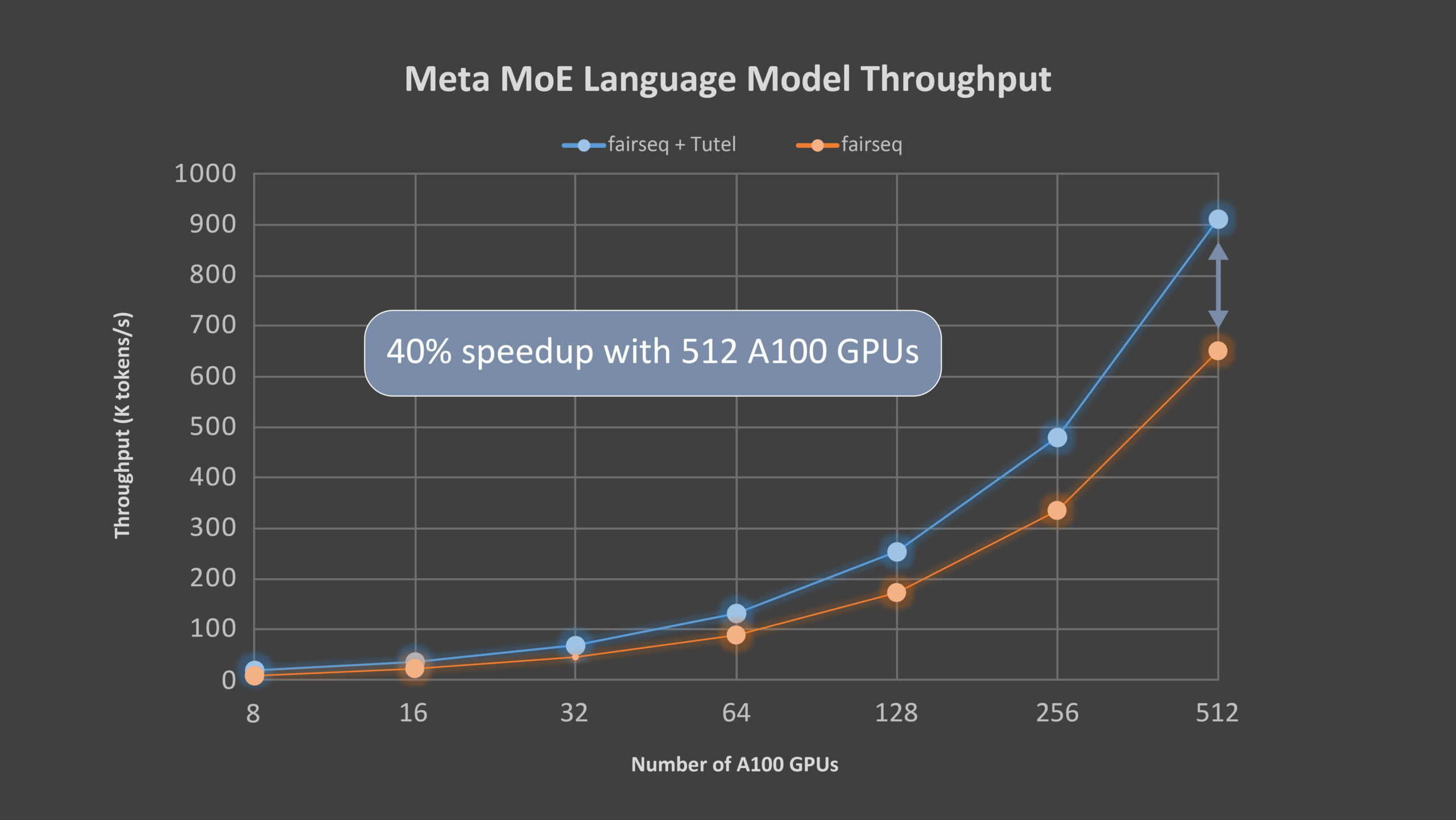
Microsoft’s Tutel primarily focuses on MoE-specific calculation enhancements. The library is designed specifically for Microsoft’s new Azure NDm A100 v4 series instances, which offer a sliding scale of Nvidia A100 GPUs. Tutel’s MoE algorithmic support is broad and versatile, allowing developers across AI fields to implement MoE more quickly and efficiently. Tutel delivers an 8.49x speedup on an NDm A100 v4 node with 8 GPUs and a 2.75x speedup on 64 NDm A100 v4 nodes with 512 A100 GPUs when compared to state-of-the-art MoE implementations like Meta’s Facebook AI Research Sequence-to-Sequence Toolkit (fairseq) in PyTorch for a single MoE layer. This is a significant benefit because existing machine learning frameworks such as TensorFlow, PyTorch, and others lack a practical all-to-all communication library, resulting in large-scale distributed training performance loss.
The present MoE-based DNN model depends on the splicing of numerous ready-made DNN operators supplied by deep learning frameworks to generate MoE calculations due to a lack of efficient implementation methods. This strategy might incur substantial performance overhead due to the necessity for duplicate calculations. Here, Tutel proves handy by enabling the creation and development of many highly efficient GPU cores to offer operators for MoE computations.
Tutel, in addition to other high-level MoE solutions such as fairseq and FastMoE, focuses on the optimizations of MoE-specific computation and all-to-all communication, as well as other diversified and flexible algorithmic MoE support. Tutel features a concise user interface that makes it simple to combine with other MoE systems. Developers may also leverage the Tutel interface to embed independent MoE layers into their own DNN models from the ground up, gaining direct access to the highly optimized state-of-the-art MoE capabilities.
“MoE is a promising technology. It enables holistic training based on techniques from many areas, such as systematic routing and network balancing with massive nodes, and can even benefit from GPU-based acceleration,” explains Microsoft.
Tutel, which displayed a significant gain over the fairseq framework, has also been included in the DeepSpeed architecture. Tutel and related integration are expected to benefit additional Azure services, particularly for clients looking to expand their own huge models easily. MoE is still in its initial stages today, and more work is needed to fully fulfill its potential. Consequently, scientists will continue to improve Tutel in the hopes of bringing you even more exciting research and application results in the future.
Universidad Carlos III de Madrid (UC3M) and Inrobics Social Robotics, S.L.L have combinedly developed a robotic device that provides cognitive rehabilitation services and therapy assistance to patients. Social robots are officially certified as a medical device that aims to revolutionize the health sector through automation. These social robots can help patients with functional or neurological disorders to improve their quality of life by providing treatment for enhancing motivation, stimulating concentration, changing behavioral patterns through practice and feedback.
The entire therapy process is done by four elements — a robot that interacts with the patient, an application that can be used by healthcare staff to set up and track sessions, an artificial intelligence system that uses a 3D sensor for controlling the robot, and a cloud-based storage system that contains information from all rehabilitation process done by the robots.
The AI-based robot acts as an intelligent co-therapist that socially interacts with patients and offers them a series of activities or a number of exercises that patients have to follow. In addition, the robot also gives feedback to the patients on how to improve their motor skills or cognitive abilities.
The therapy staff/doctor specially customizes every therapy given by the robot according to every patient’s need.
Since Inrobics is a cloud-based service, it can be used in both rehabilitation centers and respective patient’s homes. For providing external assistance, they offer the Inrobics app. This app enables patients/users to set up therapy sessions with robots. The app also provides real-time insights and reports of a patient’s behavioral development and recovery.
Artificial intelligence startup Landing AI raises $57 million in its Series A funding round led by industrial IoT investor McRock Capital. Other investors like Insight Partners, Taiwania Capital, Canada Pension Plan Investment Board (CPP Investments), Intel Capital, Samsung Catalyst Fund, Far Eastern Group’s DRIVE Catalyst, and Walsin Lihwa also participated in the funding round.
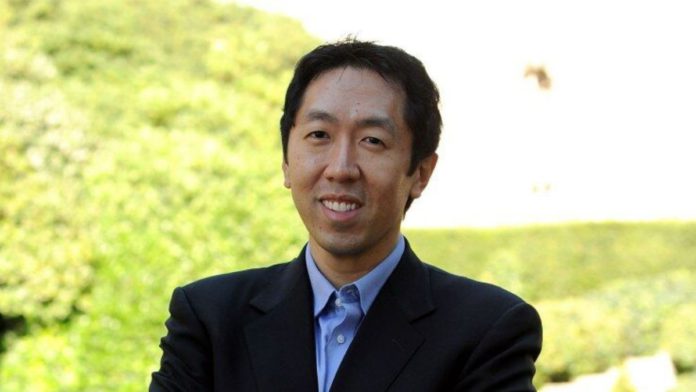
The founder of this AI startup is the co-founder of Google Brains research lab and former chief scientist at Baidu, Andrew Ng. With this fresh funding, Landing AI plans to further improve its product LandingLens, and extensively hire trained professionals to meet their goals. Landing AI plans to increase its team size from 75 to 150 while adding on more customers.
Andrew Ng said, “AI built for 50 million data points doesn’t work when you only have 50 data points. By bringing machine learning to everyone regardless of the size of their data set, the next era of AI will have a real-world impact on all industries.”
He further added that it is important to have good quality data in order to win with artificial intelligence. United States-based Landing AI was founded in 2017 and specializes in developing artificial intelligence solutions for challenging visual inspection problems and generating business value.
Additionally, Co-Founder and Managing Partner of McRock Capital, MacDonald, will join Landing AI’s board of directors. “Landing AI will unleash the power of the Industrial IoT one company, one factory, and one manufacturing line at a time,” said MacDonald. He also mentioned that he believes Landing AI will be able to bring a transformation in digital technologies for various markets.
George Mathew, managing director at Insight Partners, said that the need for Landing AI is ever increasing, and he believes the company will be able to unlock untapped segments of machine vision projects.”
Enterprise healthcare solutions developing company Novarad partners with artificial intelligence-powered medical imaging products developing firm CureMetrix to develop new AI-driven mammography solutions.
With this collaboration, both companies plan to integrate their products to launch more capable solutions. Novarad’s imaging tools will be integrated with CureMetrix’s artificial intelligence-powered women’s health suite of tools for mammography.
The new product will be distributed in various regions throughout the United States. Novarad will be the exclusive distributor of the integrated systems for small to medium-sized imaging centers and hospitals across the USA.
The solution will drastically reduce the reading time of mammographies by 30% that would result in early diagnosis of breast cancer patients. The solution will also bring down the false positives by 60%.
Novarad’s director of product, David Grandpre, said, “By integrating these highly trained, proven algorithms with our existing mammography offerings, radiologists will be able to streamline their workflow, reduce false positives and enhance their ability to diagnose breast cancer earlier.”
He further added that the company’s vision is similar to CureMetrix’s goal of supporting women’s health. Coremetrics is a United States-based artificial intelligence company that was founded by Navid Alipore, Homa Karimabadi, Kevin Harris, and Blaise Barrelet in 2014.
According to the company, it is the global leader in artificial intelligence for medical imaging. Coremetrics products help healthcare practitioners to accurately identify and classify any anomalies in mammography.
CEO of CureMetrix, Navid Alipore, said, “CureMetrix solutions will enhance the performance of physicians using Novarad’s outstanding platforms, improving both clinical and financial outcomes both now and well into the future.” He also mentioned that their integrated solution would aid radiologists in diagnosing breast cancer at an early stage to decrease fatality chances.
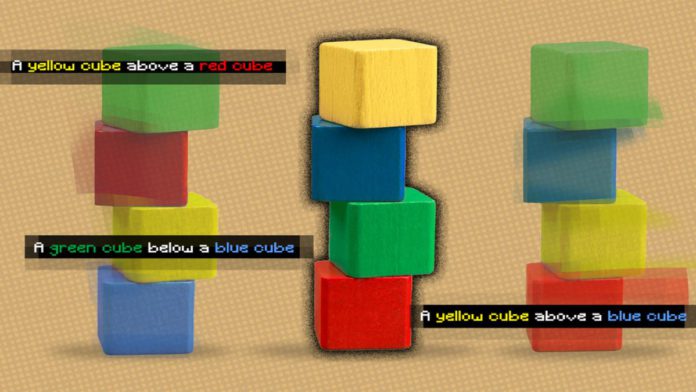
When humans see, they understand the scene by relating with objects. However, deep learning models struggle to understand the entangled relationships between individual objects. Without knowledge of object relationships, a robot that’s supposed to help someone in a kitchen would have difficulty following complex commands like “pick up the spatula that is to the left of the stove and place it on top of the cutting board.” MIT researchers have developed an AI model that understands object relationships to solve this problem. The model works by representing individual relationships and then combining them to describe the overall scene, enabling the model to generate more accurate actions.
The framework generates an image of a scene based on a text description of objects and their relationships. Next, the system would break these sentences down into smaller pieces to describe each relationship. It then combines the smaller relationships through an optimization process that generates an image of the scene. In addition, breaking sentences allows the system to recombine shorter pieces in various ways, making it better to adapt to new scene descriptions.
“When I look at a table, I can’t say that there is an object at XYZ location. Our minds don’t work like that. In our minds, when we understand a scene, we really understand it based on the relationships between the objects. We think that by building a system that can understand the relationships between objects, we could use that system to more effectively manipulate and change our environments,” says Yilun Du, a Ph.D. student in the Computer Science and Artificial Intelligence Laboratory (CSAIL) and co-lead author of the paper.
Other co-lead authors on the paper were Shuang Li, a CSAIL Ph.D. student, and Nan Liu, a graduate student at the University of Illinois; Joshua B. Tenenbaum, Professor of Cognitive Science and Computation; and senior author Antonio Torralba, the Delta Electronics Professor of Electrical Engineering and Computer Science. In December, they will present the research in a paper titled Learning to Compose Visual Relations at the Conference on Neural Information Processing Systems.
The researchers used energy-based models, a machine-learning technique to represent the individual object relationships in a scene description. The system also works in reverse, finding text descriptions when given an image that matches the relationships between objects in the scene. In addition, their model can edit an image by rearranging the objects in the scene to fit a new description.
The MIT researcher’s model outperformed the baselines compared to other deep learning methods that were given text descriptions and tasked with generating images that displayed the corresponding objects and their relationships. They also asked humans to evaluate whether the generated images matched the original scene description, and 91 percent of participants concluded that the new model performed better.
This research is helpful in situations where industrial robots perform multi-step manipulation tasks, like assembling appliances or stacking items in a warehouse. Li also added that their model can learn from less data but can generalize to more complex scenes. The researchers would like to see how their model performs on complex real-world images with noisy backgrounds and objects blocking one another.
OpenAI, one of the most prominent AI research laboratories, opens its most successful GPT3 model for all. The natural language model GPT-3 is now publicly available for developers and enterprises to work on their most challenging language problems. Developers can use the GPT-3 model by accessing it through the APIs. Any user can visit the OpenAI website, create an account by signing up, and start working with GPT-3 instantly.
Amidst higher expectations set by the previous version GPT-2, OpenAI released GPT-3 in June 2020 with nearly 175 billion parameters. The newly launched model captured all the attention of researchers, AI businesses, and mass media as it was the largest NLP model at that time.
Even though OpenAI’s GPT-3 is not free for users, the GPT-3 API pricing was pretty decent when they first released the API for limited users.
Since the release of the GPT-3 API last year, AI enthusiasts have had to join a waitlist to get access to the API. However, only a few got access to the API because OpenAI was critical of the safety concerns; the company believed that it could be used for malicious or illegal purposes.
To solve this issue and enhance their safety measures, OpenAI has spent a year since 2020 working on both safety and reliability. Now, the company is more confident about its safety initiatives, allowing everyone to integrate GPT-3 in AI-based solutions. “Our progress with safeguards makes it possible to remove the waitlist for GPT-3,” mentioned in their official announcement.
As part of the GPT-3 API release, OpenAI has provided its user guidelines and content guidelines to clarify users/developers for what kind of content their API can generate. OpenAI has released API tools and best practices documentation to help developers bring their applications to production quickly and safely. They have also listed the supported countries that can instantly access the GPT-3 API.
“As our safeguards continue to improve, we will expand how the API can be used while further improving the experience for our users,” the organization said in its official announcement.