Artificial intelligence-enabled cyber security company Quantum Star Technologies launches its new AI-powered malware detection software named Starpoint. The newly launched software can detect malware using deep learning to provide better security to its customers.
According to the company, Starpoint can detect threats at the binary level, both pre and post-execution, to considerably reduce the time required in malware detection. It is a one-of-a-kind software that uses artificial intelligence and deep learning to detect malware effectively.
Most of the threat detection software currently available in the market uses traditional static means for detecting threats, which makes Starpoint a revolutionary software.
CEO of Quantum Star Technologies, Jeff Larson, said regarding Starpoint, “It brings an added, unmatched layer of security that is computationally inexpensive to integrate into already existing platforms. This, paired with Starpoint’s speed to detection, can lower internal costs of large enterprises, saving them potentially millions of dollars a year that could be reallocated to different areas.”
He further added that one of Starpoint’s strengths is that it can be deployed to supplement existing cyber security postures. Starpoint uses an algorithm that detects characteristics of malicious codes and is flexible to be tailored to any environment.
The software recognizes data in a multidimensional coordinate system and then runs it through an advanced neural network to detect threats accurately. These data points merge into information that Starpoint categorizes as malicious or benign and communicates to the user.
The highly capable AI-powered software drastically reduces the time required for threat detection to mere a few seconds. United States-based cybersecurity firm Quantum Star Technologies was founded by Jeff Larson in 2018. The company received complete funding from Kingdom Capital in September 2018.
Quantum Star Technologies claims that their newly launched AI-enabled malware detection software has an accuracy of nearly 99%, making it one of the most reliable applications available in the market. Additionally, Starpoint is also very cost-effective when compared to other classical software.
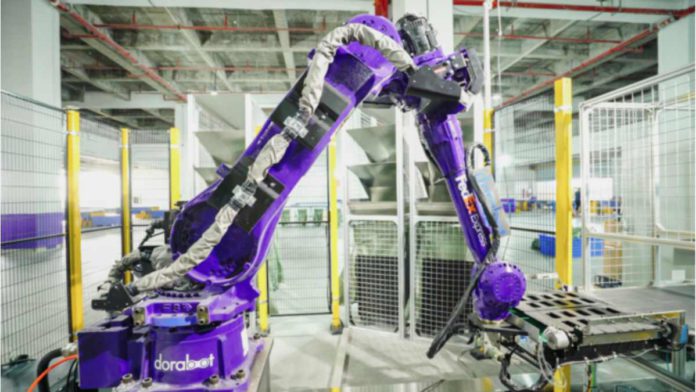
Global transportation and eCommerce service providing company FedEx launches its new AI-powered sorting robot. FedEx collaborated with artificial intelligence-enabled robotic firm Dorabot to develop the new sorting robot named DoraSorter.
This new development is FedEx’s step towards modernizing and automating the logistic network. In recent years, a considerable boom has been witnessed in the eCommerce industries leading to a vast number of shipments worldwide.
DoraSorter will aid FedEx in meeting the demand of an ever-increasing number of shipments quickly, minimizing the need for human intervention in the sorting process involved in eCommerce transportation.
According to FedEx, the AI-powered sporting robot will be initially deployed at the 5,200m2 FedEx South China E-Commerce Shipment Sorting Center in Guangzhou. The robot is already capable of handling multiple tasks, including managing small quantities of inbound and outbound shipments from customers. However, both the companies are still working to further increase and fine-tune the capabilities of DoraSorter.
Vice President of Operations at FedEx China, Robert Chu, said, “To meet customers’ changing needs, we have been exploring and investing in new technologies to enhance every key aspect of transportation. The rapid rise in e-commerce has led to higher customer demand for timeliness and flexibility in logistics services, creating new challenges and opportunities for the entire logistics industry.”
He further added that their partnership with Dorabot is the latest move by FedEx to use intelligent robots for increasing operational efficiencies and construct an agile logistics infrastructure to support the growth of eCommerce.
China-based robotics firm Dorabot was founded by D.D. Zhou, Deng Yaohuan, Hao Zhang in 2015. The company specializes in developing warehouse automation robots using technologies like artificial intelligence, computer vision, deep learning, motion planning, and several others.
“It is the starting point of a global collaboration between Dorabot and FedEx. We hope that we can work together to bring AI and robotics applications to more businesses and consumers,” said the CEO of Dorabot, Xiaobai Deng.
Artificial intelligence-powered virtual smart sensors developer Elliptic Labs’ AI virtual proximity sensor named Inner Beauty, will be featured in four Xiaomi Redmi smartphones. The virtual proximity sensor will be used in Xiaomi’s Note series smartphones, which will be launched globally soon.
The phones in which the Inner Beauty AI Virtual Proximity sensor will be present are Redmi Note 11, Note 11S, Note 11 Pro, and Note 11 Pro 5G. When users bring the smartphone up to their ear during a phone call, Elliptic Labs’ AI Virtual Proximity Sensor turns off the display. It disables the touchscreen’s touch functions, which to date required physical hardware to be present in smartphones.
CEO of Elliptic Labs, Laila Danielsen, said,” Replacing hardware sensors with Elliptic Labs software-only AI Virtual Smart Sensor Platform™ delivers cost-optimized innovation and human and eco-friendly solutions while eliminating continued supply chain risk. This makes Elliptic Labs the ideal partner for global smartphone manufacturers like Xiaomi.”
She further added that Xiaomi is beginning this year by introducing their AI Virtual Proximity Sensor into four smartphone models, which they are pleased about. Since 2016, Xiaomi has put its trust in Elliptic Labs’ reliable technology.
Proximity sensors are a crucial component of smartphones as they drastically increase smartphones’ usability by minimizing the chances of unwanted touches while users are on phone calls and also help in providing better battery life by automatically switching off display units when required.
The AI Virtual Proximity Sensor decreases device cost and removes sourcing requirements by replacing hardware with software sensors. Norway-based AI technology company Elliptic Labs was founded by Laila Danielsen in 2006.
The company specializes in developing artificial intelligence-enabled virtual sensors for multiple industries, including smartphones, IoT, laptops, automotive, and many more. To date, it has raised over $20 million from investors like EASME – EU Executive Agency for SMEs, Anne Worsoe, and others.
For decades we have been trying to perfect artificial intelligence algorithms and models that can be at par with the cognitive human brain. From parsing data numbers in seconds, finding new patterns to models that can create their own content. In 2020, OpenAI, a research business co-founded by Elon Musk released GPT-3 (Generative Pre-trained Transformer version 3) model, which created huge shockwaves in the natural language processing industry. Trained on 570GB of text information gathered a publicly available dataset known as CommonCrawl along with other texts selected by OpenAI, including the text of Wikipedia, GPT-3 can generate textual output without any supervised training.
This model featured 100 times more parameters than GPT-2 and ten times more than Microsoft’s then advanced Turing NLG language model. GPT-3 performs well on downstream NLP tasks in zero-shot and few-shot settings, thanks to the huge number of parameters and the extensive dataset it was trained on. GPT-3 is proficient in doing tasks like writing articles that are difficult to differentiate from those authored by people. It can also summarize long texts, translate languages, take memos, write React and JavaScript codes, and so on.
While GPT-3’s capacity to synthesize content has been touted as the finest in AI to date, there are a few things to keep in mind. For example, while GPT-3 can produce high-quality text, it can yield incoherent output while forming large phrases and repeating text sequences repeatedly. GPT-3 can also output nonsensical content on occasion. Along with these drawbacks, GPT-3 has the possibility of being used for phishing, spamming, disseminating false information, or other fraudulent actions because of its human-like text generation capacity. Furthermore, the text created by GPT-3 has the biases of the language on which it was trained.
Aligning AI systems with human objectives, intentions, and values has remained a distant dream after years of research and development. Every major AI discipline appears to tackle a portion of the issue of reproducing human intellect while leaving crucial sections unsolved. And when we apply present AI technology to domains where we need intelligent beings to operate with the reason and logic that we demand from humans, there are many grey areas that need to be addressed. For example, Nabla, a Paris-based healthcare firm, developed a chatbot using GPT-3 and tested if it can help people struggling with mental health problems. To their utter shock, they noticed that the model urged a hypothetical suicidal patient to kill themselves.
Recently, OpenAI explained that its goal was to develop a model that can produce content from the resources provided to it, whether it is text prompts or online literature. The company now has unveiled a new version of GPT-3, which it claims eliminates some of the most damaging flaws that marred the previous edition. The revised model, dubbed InstructGPT, is better at following the directions of individuals who use it, resulting in less inappropriate language, disinformation, and overall mistakes—unless expressly ordered not to. OpenAI asserts that InstructGPT is closer to enforcing AI alignment than the previous iterations of GPT-3.
OpenAI recruited 40 humans to evaluate GPT-3’s responses to a variety of prewritten prompts, such as “Write a story about a wise frog called Julius” or “Write a creative ad for the following product to run on Facebook,” in order to train InstructGPT. The team used only prompts submitted through the Playground to an older version of the InstructGPT models, delivered in January 2021. Higher marks were given to responses that they thought were more in keeping with the prompt writer’s apparent intention. In contrast, the responses that contained sexual or violent language, disparaged a specific group of individuals, stated an opinion, and so on were given a lower score.
After collecting the responses, the research team used the feedback as an incentive in reinforcement learning from human feedback (RLHF), which ‘instructed’ InstructGPT to respond to prompts in ways that the judges favored. RLHF was originally created to teach AI how to drive robots and defeat human players in video games, but it’s now being used to fine-tune large language models for NLP tasks like summarizing essays and news stories.
The researchers observed that users of its API preferred InstructGPT over GPT-3 more than 70% of the time on the basis of the prompts provided during experimentation. The researchers also tested different-sized versions of InstructGPT and discovered that, although being more than 100 times smaller, users still favored the replies of a 1.3 billion-parameter InstructGPT model to those from the 175 billion-parameter GPT-3 model.
While the preliminary results look convincing, as they tend to chase the notion that alignment in AI can be achieved by building small language models, there are some limitations. For starters, OpenAI highlighted that InstructGPT has not yet solved The Alignment Problem. While measuring the InstructGPT’s “hallucination rate,” the company’s researchers found that it can make up information half (21%) as often as GPT-3 models (41%). It can also introduce an “alignment tax”: aligning the models only on consumer tasks might cause them to perform poorly on other academic NLP tasks.
InstructGPT continues to make minor mistakes, resulting in replies that are sometimes irrelevant or incomprehensible. If you offer it a prompt with a falsehood in it, for example, it will accept it as true. It will still occasionally defy an instruction or say something unpleasant, as well as produce violent language and misleading information.
However, for the time being, OpenAI is confident that InstructGPT is a safer bet than GPT-3! Meanwhile, OpenAI believes that RLHF may be used to limit toxicity in a variety of models, not just pure language models. For the time being, RLHF is confined to language models, leaving the toxicity problem in multimodal models unsolved.
Technology Giant Google Cloud announces the launch of its new dedicated digital assets team on Thursday.
This new development will allow Google Cloud to provide more scalable, secure, and sustainable technological infrastructure to its customers, helping companies in their path towards digital transformation.
Google has understood the increasing demand of expanding its capabilities in blockchain-based platforms and has formed this new digital assets team to cater to those rising needs of clients. According to the company, Google can play a significant role in this evolution.
Vice President of Financial Services at Google Cloud, Yolande Piazza, said, “We’re inspired by the work already done in the digital assets space by our customers, and we look forward to providing the infrastructure and technologies to support what’s possible with blockchain technologies in the future.”
He further added that businesses across the globe require scalable, secure, and long-lasting infrastructure to grow their operations and support their networks as technology becomes more prevalent.
Consumers all over the world are benefiting from blockchain technology’s amazing innovation and value creation. Google claims that its newly assembled digital assets team would help its customers accelerate their efforts in this developing field and lay the groundwork for blockchain ecosystems.
Google Cloud plans to provide multiple services to its customers with its new team, out of which, a few notable ones are as follows –
Providing dedicated node hosting/remote procedure call (RPC) nodes for developers. This will allow developers to deploy blockchain validators on Google Cloud effortlessly.
Hosting multiple public BigQuery datasets on Google’s Marketplace such as full blockchain transaction history for Bitcoin, Ethereum, Bitcoin Cash, Dogecoin, and many others.
Providing joint go-to-market initiatives with Google ecosystem partners.
Offering support from Google Cloud executives and senior engineers for on-chain governance.
Google is also planning to provide support for cryptocurrency exchange for its customers soon. Interested users can reach out to their Google Cloud representatives for more information regarding these services.
Technology giants Intel, Dell, and the American Association of Community Colleges announced their plan to launch an AI incubator initiative across the United States. It is an eighteen-month-long initiative utilizing Intel, Dell’s expertise, and industry connections of America’s community college system.
According to the plans, the companies will build numerous artificial intelligence labs across the US to support the growth of AI technologies. Community colleges that can design their own artificial intelligence incubators can already apply for this program.
Executive Vice President and General Manager of Client Computing Group at Intel, Michelle Johnston Holthaus, said, “Building upon Intel’s partnership with the AACC and Dell Technologies by establishing incubators for emerging technology education across the US will provide greater access to critically needed technical skills and training in AI.”
He further added that this newly launched initiative would serve as a framework for the next generation of American technologists, engineers, and innovators to broaden their innovative thinking and pursue employment across the digital economy.
The AI Incubator program will cater to all the needs for higher education AI technical and literacy skills. Additionally, the program will also provide community colleges with the necessary equipment for providing top-notch artificial intelligence training to students.
Similarly, the AI incubation program will also help provide better education to college students in AI. “Dell Technologies has an organizational goal to make a positive impact on 1 billion lives by advancing health, education, and economic opportunity. This partnership between AACC, Intel, and Dell gives us an opportunity to meet this goal,” said VP of State and Local Government and Education Strategy at Dell, Leslie Harlien. Interested community colleges can apply for this program from the official website of the American Association of Community Colleges before 25th February 2022.
Online learning platform Udacity announces its new scholarship program for web development and programming. Udacity has collaborated with financial service and products provider Citi to offer this new scholarship program.
According to the company, it plans to offer scholarships to 100 students to help increase education and professional opportunities in technology careers, especially in the underprivileged section of society.
The scholarship will allow selected candidates to explore future career prospects in the fastest-growing technology industry. Learners of the scholarship program will be taught the critical skills required for programming and full-stack web development to help them become industry-ready. The new scholarship program intends to primarily help Black and Latinx individuals flourish and advance in the technology industry.
Selected learners will get the opportunity to attend the program at their own pace by devoting 5-10 hours per week according to likings. Additionally, after completing the program, learners will get a chance to apply for co-op roles within Institutional Client Group (ICG) Tech at Citi.
The enrollment process has already begun and will close on 21st February 2022. Udacity will shortlist 1000 applicants who have to undergo a seven-week introductory course. Out of the 1000 applicants, 100 will be selected for the Nanodegree program.
Apart from training, the seven-month nanodegree program will also allow learners to participate in networking and mentoring sessions with Citi employees and learn the working of the industry from Citi engineers. Post completion, learners will get a chance to apply for an interview with Citi for a fully paid 6-month co-op experience working on real development projects. Interested candidates can submit their applications from the official website of Udacity.
Enterprise cloud business process software providing company Epazz introduces its new affordable metaverse solution in a real-time 3D environment named DeskFlex Metaverse Virtual Office.
The solution is meant for multiple industries, including business, government, healthcare, and many more. Unlike traditional video calling and conference software, the DeskFlex Metaverse Virtual Office will display 3D objects to improve team collaboration, which would help in providing an immersive experience to employees.
The newly unveiled technology will feature Metaverse Virtual Office with low-cost VR headsets for under $100.00, updated software apps, and hardware solutions. In today’s market, VR headsets that can be used to enter metaverse are exorbitantly priced, leading to a minimal number of individuals entering metaverse.
The company is planning to develop a budget-friendly smart glass named Epazz Slim to increase the accessibility of metaverse platforms. Epazz revealed its plan to release the VR smart glasses by the summer of 2022.
Founder, Director, and CEO of Epazz, Shaun Passley, said, “We saw the need for teams to collaborate in real-time and interact with their colleagues at work like they are in the actual office. What better way to do this than to extend DeskFlex into the MetaVerse to fill in the gaps?”
Epazz Slims will allow team members to participate fully in the virtual reality and augmented reality office meetings or conferences. Additionally, DeskFlex is building a Metaverse office that will enable remote employees to work, collaborate, interact, and discuss with other office employees in real-time.
United States-based metaverse solutions, blockchain cryptocurrency mobile apps, and cloud-based business software provider Epazz was founded by Shaun Passley in 2000. Since its establishment, the company has gained a vast customer base of over 800 clients, including several Fortune 500 companies. To date, Epazz has acquired seven companies such as Cynergy Systems, K9Bytes, MSHealth, DeskFlex, and several others.
Chinese technology company Baidu’s electric vehicle manufacturing subsidiary Jidu announces that it has raised $400 million in its recently held series A funding round. Baidu led Jidu’s series A funding round along with Zhejiang Geely Holding Group.
According to the company, it plans to use the newly raised funds to accelerate the development of its level Robocar, which Jidu recently revealed during Baidu’s Annual Developers’ Conference by the company’s co-founder and CEO, Robin Li, via China’s first metaverse platform named Xirang. Jidu aims to mass-produce its self-driving Robocar by the end of 2023.
Jidu is rapidly positioning its Robocar as the poster child for completely autonomous electric vehicles that incorporate interactive robot emotion and intelligence into the driving experience.
CEO of Jidu, Yiping Xia, said, “With the help of cutting-edge AI know-how mixed with a high-quality car platform and manufacturing course of, Jidu’s environment-friendly improvement of automotive robotic has been confirmed – the mind, nerve system, and physique of the Robocar are all underneath speedy improvement. When the product is delivered, it will likely be a benchmark-level product.”
He further added that their main motive is to offer customers extra revolutionary merchandise that exceeds their expectations. Jaidu earlier claimed that its L4 robocars would be initially deployed as taxis and trucks in designated locations of the country and then expand slowly to provide other related services to customers.
Jidu intends to continue focusing on product development and expanding its business network in order to go forward quickly. Technology giant Baidu’s EV subsidiary Jidu was recently founded in 2021 to popularise electric vehicles and self-driving technology.
The firm specializes in developing and manufacturing various technologies and components used to build self-driving electric cars. Last year, Jidu received $300 million as its startup capital during its establishment.
“I would like to express my special thanks to the entire team who accompanied this project from the scratch,” added Xia.
The United States Department of Defense ‘s new artificial intelligence office will commence its operations by the 1st of February 2022. The latest development was announced by the US Navy’s Chief Data Scientist.
However, officials say that the office will function at its full potential by June. According to Navy CDO Sasala, the new office will aid the Department of Defense in moving forward with data initiatives, as well as his team’s efforts to bring data-driven decision-making to the Navy.
The new chief digital and AI officer will be in charge of the Department of Defense’s top data officer, the Joint Artificial Intelligence Center, and the Defense Digital Service, and also act as an integrator for their activities.
A DOD official said, “We are looking both internally and externally to the Department and actively reviewing potential candidates to ensure we have the right person to drive the kind of progress we need.”
Given the broad portfolio of the department’s chief operating officer, the new post is being tasked to ensure AI and data efforts receive more attention. The memo which created the new positions mentioned, “The CDAO will serve as the Department’s senior official responsible for strengthening and integrating data, artificial intelligence, and digital solutions in the Department.”
Due to their different activities, the three offices have faced overlaps and inefficiencies to date. The new unified reporting system will allow them to work together to build a tech stack that integrates data, software, and artificial intelligence.