CEO of Tesla and the world’s richest man Elon Musk recently hinted that he might soon start his own open-source social media platform that will support the integration and use of Dogecoin.
Given that Twitter serves as the de facto public town square, failing to adhere to free speech principles fundamentally undermines democracy.
In a recent tweet, Musk said that he was unsure about the policies of Twitter and doubted the platform’s norms in promoting freedom of speech.
He asked his 79 million Twitter followers if they thought Twitter “rigorously conforms” to the notion that “free expression is important to a functioning democracy.” As always, Twitteratis flooded the platform with their opinions following Musk’s tweet.
Free speech is essential to a functioning democracy.
Do you believe Twitter rigorously adheres to this principle?
People showed diverse views regarding the matter, where some supported Musk while others claimed that Twitter was doing just fine. A user tweeted, “Twitter is a PRIVATE company, free speech doesn’t apply to you here.” Some users also urged Elon Musk to buy Twitter.
More than 70 percent of the 2 million respondents clicked ‘no,’ prompting Musk to propose a new platform. Any new platform he creates would include a digital tip jar that would support the meme-inspired cryptocurrency Dogecoin, added the CEO of Tesla.
Musk has always been a supporter of decentralized cryptocurrencies and has earlier also accepted payments via Bitcoin for Tesla, but the service was terminated. A few months earlier, Tesla announced that it plans to accept Dogecoin as payment at its Supercharging station in Santa Monica, United States.
Dogecoin was created by Billy Markus and Jackson Palmer to mock Bitcoin. However, Dogecoin achieved much recognition after it grabbed the attention of Elon Musk. The cryptocurrency’s logo and the name are based on a viral meme involving a Shiba Inu dog.
Massachusetts Institute of Technology (MIT) announces the launch of its new AI Hardware program aimed to boost artificial intelligence innovations in the hardware industry.
It is a new collaboration between academics and industry aimed at defining and building translational hardware solutions for the AI and quantum age.
According to MIT, its newly launched AI Hardware program will develop a roadmap for cutting-edge AI hardware.
MIT School of Engineering and MIT Schwarzman College of Computing have partnered to innovate technologies to deliver enhanced energy efficiency systems for cloud and edge computing.
The MIT AI Hardware Program brings together MIT and industry researchers to help bridge the gap between fundamental knowledge and real-world technical solutions in fields like devices, algorithms, and many others. Jess del Alamo and Aude Oliva are co-directors of the new program, which is chaired by Anantha Chandrakasan.
Dean of MIT School of Engineering and Vannevar Bush Professor of Electrical Engineering and Computer Science, Anantha Chandrakasan, said, “A sharp focus on AI hardware manufacturing, research, and design is critical to meet the demands of the world’s evolving devices, architectures, and systems.”
Chandrakasan further added that the future of high-performance computing depends on collaboration between industry and academics. The program invites multiple industry-leading companies as its inaugural members, including Amazon, Analog Devices, ASML, NTT Research, and TSMC.
MIT says that the AI Hardware program will prioritize various topics like analog neural networks, heterogeneous integration for AI systems, software-hardware co-design, AI edge security, wireless technologies, hybrid-cloud computing, etc.
“We are all in awe at the seemingly superhuman capabilities of today’s AI systems. But this comes at a rapidly increasing and unsustainable energy cost,” said Jess del Alamo.
Jess also mentioned that Continued advancement in artificial intelligence would require the development of new, more energy-efficient systems, which will demand breakthroughs throughout the entire abstraction stack, from materials and devices to systems and software.
Apple recently announced a Supplier Employee Development Fund worth $50 million to expand learning opportunities for upskilling its supply chain.
According to Apple, the funds will be utilized in multiple supply chains, including India, China, Vietnam, and the United States.
Apple will also use the announced funds for new and extended relationships with prominent human rights organizations, universities, and nonprofits to support Apple’s continued efforts to empower suppliers and increase workplace rights awareness and respect across industries.
Over the years, Apple has been providing upskilling programs that allow individuals to gain critical technical and leadership skills required in the industry. The Supplier Employee Development program is a step further towards this goal of Apple by offering new educational resources for people in its supply chain.
Senior Director of Environment and Supply Chain Innovation, Sarah Chandler, said, “We put people first in everything that we do, and we’re proud to announce a new commitment to accelerate our progress and provide even more opportunities for people across our supply chain.”
She further added that they are continuing to drive innovations to benefit people and the earth in collaboration with rights advocates and education experts.
Apart from this program, Apple also announced its 16th edition of the People and Environment in Our Supply Chain report, which describes the ways Apple and its suppliers support the supply chain. The report includes various factors such as the company’s consumption and adoption of clean energy, investment in new-age technologies, and many others.
Moreover, Apple stated that it would engage with UN agencies such as the IOM (International Organization for Migration) and ILO (International Labor Organization) to expand its work, including launching additional programs, training, and worker feedback systems to maintain a safe and respected work environment for employees throughout its supply chain.
Deputy General Manager for Management and Reforms at IOM, Amy Pope, said, “The IOM and Apple partnership has proven results in Apple’s own supply chain and paves the way for others in the industry to follow.” Pope added that Apple’s new promises would assist workers all over the world in a practical and meaningful way.
Online reselling platform Meesho appoints Debdoot Mukherjee as its new Chief Data Scientist to boost the use of data in its platform.
Data science and artificial intelligence have gained immense popularity over the last few years due to their value to any business, especially for companies that operate in the digital space.
Meesho plans to use the expertise of Mukherjee to expand its capabilities in reaching and retaining more customers on its platform.
Mukherjee, a double gold medalist from the Indian Institute of Technology (IIT) Delhi, will be in charge of the company’s attempts to apply artificial intelligence and head a 30-man team to boost the effective utilization of data and AI.
He is an industry expert in the field of artificial intelligence and data science and has previously led teams in multiple leading organizations, including ShareChat, Hike, and Myntra, successfully.
Mukherjee’s past achievements include developing a feed ranking system and AI models for Moj (ShareChat) that were able to drastically increase engagement and user retention.
“I join Meesho feeling deeply connected with their mission of democratizing internet commerce for everyone in India. AI can play a central role in creating an efficient and healthy marketplace, which is trusted and loved by the customers and also ensures fairness and growth to all the sellers,” said Mukherjee.
He further added that he believes that his previous experiences will aid in the development of a world-class AI team and equipment to help Meesho achieve its ambitious goal of creating a single shopping destination for India’s next billion people.
Meesho has already been using AI and ML to offer customized recommendations to its customers and optimize sellers on its platform. This new addition to its team will further help the company unleash artificial intelligence’s full potential for skyrocketing its growth and presence in the highly competitive Indian market.
CTO and Founder of Meesho, Sanjeev Barnwal, said, “I am delighted to welcome Debdoot as the Head of Meesho’s highly energetic AI team. His leadership and deep understanding of the field will help us meet the growing demands of our users, drive innovation and accelerate our sellers’ success.”
Technology giant Amazon announces the launch of its largest office in Tamil Nadu, located in the state capital Chennai’s World Trade Center building.
The Chief Minister of Tamil Nadu, M.K. Stalin, inaugurated the new Amazon office in a recently held opening ceremony. Thiru Mano Thangaraj, Minister of IT, Government of Tamil Nadu, Thiru Neeraj Mittal, Secretary, Department of IT, Government of Tamil Nadu, and other senior government officials were also present at the inauguration event.
Amazon’s new Chennai office is spread across 8.3 lakh square feet occupying eighteen floors, with a capacity of nearly 6000 employees. However, no information was provided by Amazon regarding the current strength of its workforce in the office.
The office building incorporates internationally recognized construction standards, resulting in best-in-class architecture and facilities that will operate at substantially lower costs than any traditional building.
Amazon claims the office to be highly energy efficient as it would offer a nearly 23% reduction in annual energy consumption.
“The infrastructure developments in Tamil Nadu have been a result of our investment-friendly policies and commitment to creating new jobs for the talent pool in the state. We believe that the launch of Amazon’s new office in Chennai will have a multiplier effect on the state economy,” said the Chief Minister, M.K. Stalin.
He further added that the state’s economic and social well-being would be linked to the newest expansion and investment. Stalin also congratulated the Amazon team for launching its new office.
Amazon has established multiple preventative health measures as instructed by the government for its employees, associates, and partners to provide a healthy working environment. The office will function at its full capacity as the COVID-19 situation and restrictions start to relax.
Director of Global Retail Estate & Facilities at Amazon, Vinod Mathews, said, “The new office is a reaffirmation of our growth and commitment to the state, and we will continue to expand and invest in our employee base in the region to serve our customers and enhance their experience.”
Artificial intelligence company Qure.ai raises $40 million in its recently held funding round led by Novo Holdings and HealthQuad. Existing investors like MassMutual Ventures also participated in the funding round.
The company says it plans to use the fresh funds to further accelerate its product development process and expand into other markets, including the United States and Europe.
With powerful technology that reads and interprets medical images like X-rays, CT scans, and ultrasounds in less than a minute, Qure.ai has earned a reputation in the market by providing top-notch technology-enabled healthcare solutions for people across the globe.
The company has also received certifications and approvals from FDA, CE, and the World Health Organization, assuring the quality of Qure.ai’s products. Last year, Qure.ai got its second clearance from the FDA of the United States for its brain CT scan artificial intelligence quantification product qER-Quant.
Head of Novo Holdings Asia, Dr. Amit Kakar, said, “Qure.ai is at the forefront of transforming diagnostics in both acute and chronic ailments, which is fully aligned with our mission of advancing high-quality and accessible healthcare using innovation and digitization. Further, we are excited to connect Qure.ai to our portfolio partners as we see several promising synergies.”
He further added that they are thrilled to join Qure.ai’s amazing team and contribute to their efforts to provide world-class AI solutions in the imaging domain for the benefit of patients worldwide.
Mumbai-based health tech startup Qure.ai was founded by Prashant Warier and Pooja Rao in 2016. The firm specializes in developing deep learning and artificial intelligence solutions to aid physicians with diagnosis and routine treatments of patients. To date, Qure.ai has raised more than $60 million over three funding rounds.
Co-founder and CEO of Qure.ai, Prashant Warier, said, “Every year our technology helps more than four million people across 50 countries. Our goal is to continue being bullish in our market expansion, especially in the US and Europe.”
He also mentioned that they are dedicated to assisting healthcare practitioners in identifying illnesses faster, more accurately, and with greater information while automating the majority of the mundane job.
Business productivity-improving application developing company Otter.ai announces the launch of its new artificial intelligence-powered meeting summary feature named Automatic Outline for multiple platforms.
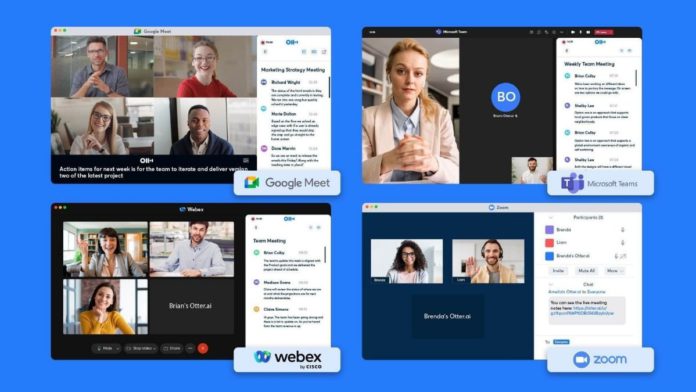
The new feature will be available on the company’s AI assistant that customers can use to transcribe meetings conducted on Zoom, Microsoft Teams, Google Meet, and others.
Automatic Outline uses conversational AI to convert audio-video meetings into actionable workflows.
According to the company, their newly launched feature comes with the capacity to collect, assign, and comment on action items directly from automated notes, along with a live AI-generated meeting outline and summary.
Otter.ai mentioned that it also plans to roll out this update for Android and iOS over the coming weeks. Users will now be able to view, join, and record Zoom meetings directly from Otter.
Co-founder and CEO of Otter.ai, Sam Liang, said, “We all spend too much time in meetings, and I am really excited about the power of AI to make meetings more productive.”
He further added that the updated Otter makes meeting collaboration easier and faster, making it a must-have tool for today’s hybrid, in-person, and virtual meetings.
The Otter Assistant feature is available in the paid plans of Otter subscription, which starts from $8.33 per month billed annually and provides limited trial access to the feature.
United States-based artificial intelligence software developing company Otter.ai was founded by Sam Liang and Yun Fu in 2016. Otter.ai is best known for its award-winning product, Otter Voice Notes, used by business professionals, journalists, and students to generate rich notes that can be shared and searched quickly.
To date, the firm has raised around $63 million from investors like Spectrum Equity, Horizon Ventures, Fusion Fund, Duke Angel Network, and many others over three funding rounds.
Interested users can visit the official website of Otter.ai to check out the product.
Deepfakes have been taking over the internet for the past couple of years. Therefore, it is not surprising to learn about the emergence of new ai-generated deepfake media every now and then. Meanwhile, a recent study found that humans are unable to distinguish between real faces and AI-generated faces, indicating how ‘realistic’ deepfakes have grown.
In the last several years, generic AI algorithms have become quite proficient at creating human faces. Computers can already generate images of human faces that nearly resemble real ones thanks to the use of neural networks and deep learning. On the one hand, this might be beneficial because it allows low-budget businesses to make commercials, thus decentralizing access to important resources. Faces created by AI, on the other hand, can be used for fraud, propaganda, disinformation, and even revenge pornography.
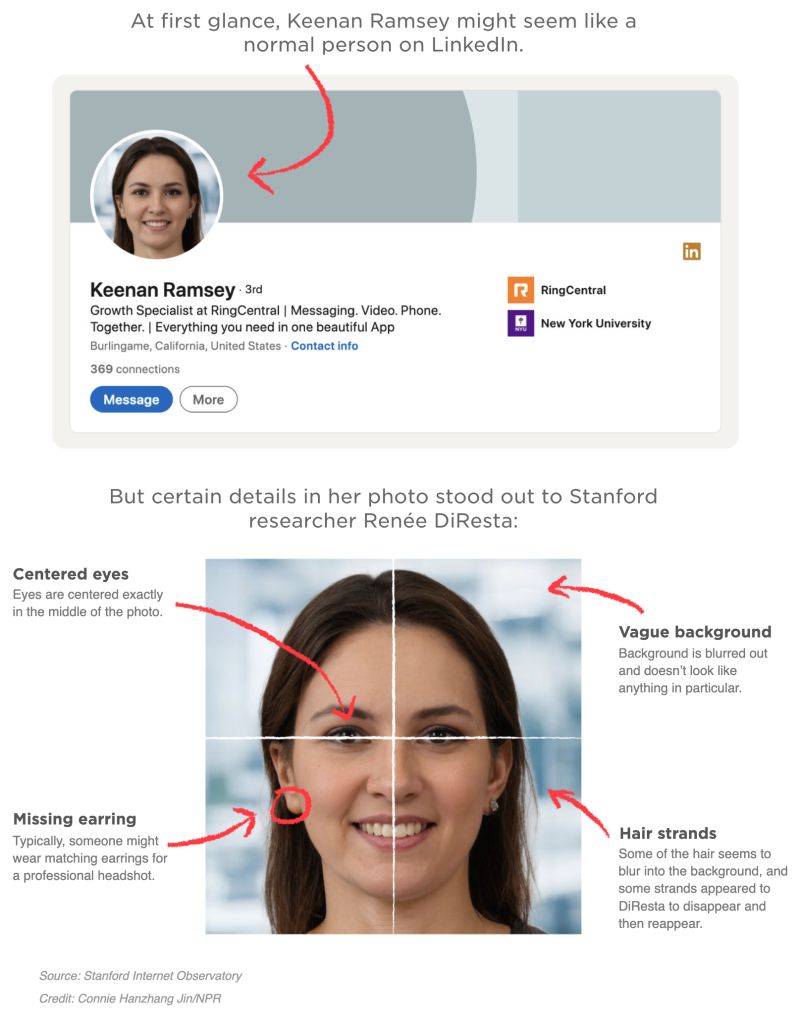
However, in the latest development, more than 1,000 LinkedIn profiles were discovered using facial images that appeared to be AI-generated, according to researchers at Stanford Internet Observatory. One of the main researchers, Renée DiResta, had been approached on Linkedin by someone named Keenan Ramsey with a sales pitch. Apparently, Ramsay had messaged her, “Quick question — have you ever considered or looked into a unified approach to message, video, and phone on any device, anywhere?” Ramsay’s bio said that they had a bachelor’s degree in business administration from New York University.
While DiResta initially thought the LinkedIn message was legitimate, a closed examination of Ramsey’s profile picture caught her off guard. DiResta noticed that Ramsey’s eyes were perfectly aligned in the middle of the picture. The image’s backdrop is frequently severely blurred, with no discernible components such as curtains, bookcases, or other items. Individual strands of hair are also prone to irregularities, with the strand appearing to end in nothing only to resume shortly thereafter. Also, DiResta observed that Ramsay had only one earring which is unusual as women generally wear two earrings, one on each ear. She even claims to hold a bachelor’s degree in business administration from New York University and lists CNN, Unilever, Amazon, and philanthropist Melinda French Gates among her interests.
This motivated her to start looking into the frequency of AI-generated – or deepfake – images on LinkedIn accounts along with her colleague Josh Goldstein.
According to NPR, many of these phony identities are being employed as a marketing tactic to generate interest in legitimate businesses. An actual individual is contacted via a false profile, and if they show interest, a real salesman takes over the conversation. Over 70 businesses were mentioned on these 1,000 fictitious profiles, with several of them informing NPR that they recruited outside marketers to increase sales. It is believed that one of the incentives behind creating false profiles could be to get past LinkedIn’s organic messaging volume constraints.
Most of the fake profiles had job position titles like ‘Business Development Manager’, ‘Sales Development Executive’, ‘Growth Manager’, and ‘Demand Creation Specialist’ for top companies. However, during the investigation, none of the companies mentioned having any record of the said ‘individuals.’ NPR reached out to 28 colleges to inquire about 57 of the profiles. None of the claimed graduates were found in any of the 21 schools that replied.
Fake accounts are a common way to propagate certain messages, dupe individuals, and create attention around specific issues. Countries like China and Saudi Arabia have already been reported to have been resorting to such tactics for various reasons.
In the case of LinkedIn, it appears that fake profiles are being utilized to build attention about certain businesses. AirSales is one of these vendors, and it claims to recruit independent freelancers to perform marketing services, and that these contractors are free to create LinkedIn accounts “at their own discretion.”
According to AirSales CEO Jeremy Camilloni, “to my knowledge, there are no explicit rules for profile pictures or the use of avatars. This is really rather prevalent among LinkedIn’s tech users.”
RingCentral, one of the firms that appeared to be employing the fake accounts (including Ramsay’s), declined to comment on its involvement in the usage of AI-generated deepfakes. However, the company did mention that it has no record of Ramsey as an employee.
The popularity of websites like ThisPersonDoesNotExist.com demonstrates that using GANs (generative adversarial networks) to build deepfakes has become very simple in recent years. These networks function by sifting through massive amounts of data (in this example, a large number of photos of actual people), learning patterns, and then attempting to duplicate what they’ve discovered.
The fact that GANs test themselves is one of the reasons they are so good. Faces are generated by one component of the network (generator), which is then compared to the training data by the other (discriminator). The generator’s task is to convince the discriminator that the pictures are authentic. As the discriminator improves at distinguishing AI-generated images, the generator creates increasingly realistic images to deceive the discriminator. Think of it like a pastry chef attempting to create a new dish and unwilling to give up until the recipe is perfected.
Although users might simply create a LinkedIn account using stock photographs or random social network photos, using an AI to create a deepfake provides an extra degree of security. Because each image is unique, it cannot be traced back to a source for simple refutation via a reverse image search.
These LinkedIn profile pictures created by deepfake software highlight how a technology that has been exploited to spread disinformation and hate online has made its way into the corporate environment. According to a community report on LinkedIn’s transparency page, the company removed more than 15 million fake accounts in the first half of 2021, with automatic defenses stopping the majority of them. Following the Stanford researchers’ warnings, LinkedIn said it investigated and deleted those profiles that violated its regulations, including those with falsified information. LinkedIn did not provide any information regarding the investigation process.
This isn’t the first time an AI-faced bot network has appeared on social media. Multiple identities purportedly belonging to Amazon warehouse employees were removed from Twitter in 2021, with many of their profile images appearing to be generated by deepfake AI tools. Amazon denied any connection to the personas or their tweets, as well as any responsibility for them.
Instead of attempting to make a less-than-direct sale, Twitter bots from Amazon and other sources often spread disinformation and propaganda on behalf of companies and governments.
Though the creation of fake profiles using AI-generated deepfake images does not sound alarming, it is a precursor of the chaos deepfakes can inflict in the future. At the same time, nations like China are already taking measures to regulate the creation and spread of deepfakes over the internet and other mainstream media. In January, China’s internet watchdog the Cyberspace Administration of China (CAC) announced new guidelines for content providers that modify face and voice data, in the country’s fight against “deepfakes.”
Wearable and teleoperated industrial robotics developer Sarcos Technology and Robotics Corporation announces its plans to acquire intelligence mobile manipulation systems developer RE2 in an acquisition deal worth $100 million.
According to the company officials, the acquisition deal will include $30 million in cash and $70 million in Sarcos stock.
RE2’s acquisition will allow Sarcos to leverage the expertise of RE2 to further improve and develop better robotic technologies that will enhance worker safety and productivity.
The merged company will initially offer multiple products, including the GuardianXO, Guardian XT teleoperated dexterous mobile robotic avatar system, Sapien, and several others. The announced products are aimed at a considerably wider range of customer requirements in both the commercial and defense sectors.
Additionally, the companies will merge RE2’s Detect outside computer vision system and Intellect autonomy software with the Sarcos Cybernetic Training for Autonomous Robots (CYTARTM) AI and machine learning program to accelerate robotic autonomy.
President and CEO of Sarcos, Kiva Allgood, said, “This transaction brings an innovative company with a complementary but additive suite of products into the Sarcos family, allowing us to offer a much wider range of solutions to address our customers’ needs.”
He further added that the acquisition would also enable them to expand their services into new fields such as medical and subsea, strengthen their robotics team, and accelerate the development of AI technologies for usage in unstructured environments. The complete transaction is expected to close by the second quarter of this year.
President and CEO of RE2, Jorgen Pedersen, said, “Across the globe, robotic technologies are changing the way workers perform complex, often dangerous tasks, particularly during a time of widespread skilled labor shortages.”
He also mentioned that Sarcos can now provide a wider range of robotic solutions to a bigger customer base as a result of their merger.
America’s fastest-growing pizza brand, Marco’s Pizza, announces that it is testing a new automated voice-to-text ordering system using conversational AI.
Currently, the technology is being tested across 50 Marco’s Pizza stores, and it plans a systemwide rollout of the technology by the end of this year.
In its initial beta testing, the speech-enabled application used conversational artificial intelligence, which resulted in 100 percent order accuracy.
The significant advantage of this AI-powered system is that it drastically improves customer experience and satisfaction by making the ordering process simpler compared to traditional methods.
Senior Vice President and Chief Information Officer at Marco’s Pizza, Rick Stanbridge, said, “There are places where AI makes sense within the business – where it creates a better experience for both team members and guests.”
He further added that this technology not only provides franchisees with a cost-effective, practical solution for reducing labor expenses and driving outcomes but it also supports team members while improving the visitor experience.
The company feels that deploying this AI-powered technology will be critical in achieving the brand’s goal of an 85 percent digital presence. Marco’s Pizza started the initial testing of the program back in 2021, intending to provide a seamless interaction experience with its customers.
According to the company, its artificial intelligence solution takes voice orders and automatically converts them to text in the point-of-sale system, which helps employees get started with customer orders quickly. It simulates a human-like interaction using conversational AI and can convert voice across different digital channels and technology platforms.
Additionally, the technology also helps employees significantly reduce their call abandonment rates.
“There are a lot of technologies on our radar, but our strategy is to hotly pursue those that we can bring to the market quickly and will have the biggest impact on customers, team members, and franchisees,” added Stanbridge.
However, not every Marco’s Pizza customer seemed to like the new technology and preferred to stick with the traditional method of ordering food.