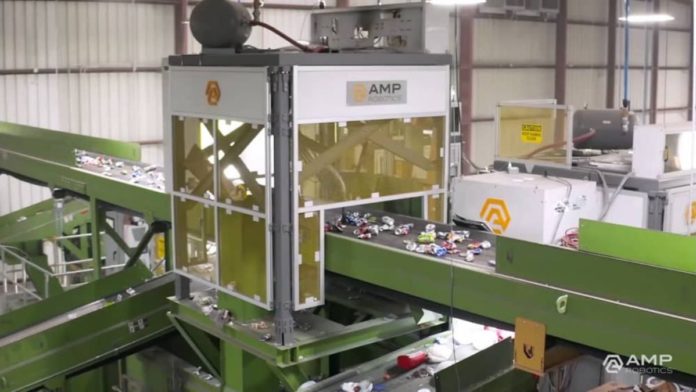
AI-based robotics company AMP Robotics partners with Agrex-Eco to launch their new artificial intelligence-powered recycling demonstration site in Poland. With this launch, AMP Robotics plans to expand its presence in Europe by deploying a demonstration site at the SIGMA SA facility located in Lublin.
The company’s new AI-powered robot accurately identifies items like papers, plastics, metals, and many more during the sorting process to increase recycling speed. Waste management and recycling companies are open to using the new setup.
Agrex-Eco will act as the official distributor of the product for customers in Poland. Agrex-Eco is a comprehensive service-providing company operating in the market for the last 30 years. It provides technical assistance and machine consultation to customers.
European general manager of AMP Robotics, Gary Ashburner, said, “We’re mutually committed to lowering the cost of recycling and improving material recovery, and look forward to opening our doors to the waste and recycling community to show how our systems, powered by the industry’s largest AI dataset, can transform their operations.”
He further added that the launch of their new demonstration site is a big step towards the company’s expansion in the European market. Last year AMP Robotics installed its first artificial intelligence-enabled robotic sorting system in partnership with REP-TEC Advanced Technologies for its customers in the United Kingdom and Ireland.
CEO of Agrex-Eco, Jacek Zawadzki, said, “The robot we’ve installed at the SIGMA reference site offers a great look for future customers and other interested parties at a system that’s shifting the industry’s economics.”
Colorado-based scalable robotics systems developing firm AMP Robotics was founded by James Bailey and Matanya Horowitz in the year 2015. The company specializes in developing machine learning and computer vision-based robots that automate various tasks involved in the recycling process like sorting, identification, processing of material streams, auto shredding, and many more.
AMP Robotics has raised a total of $74.5 million over six funding rounds from investors like Sequoia Capital, XN, Valour Equity Partners, Closed Loop Partners, and many others.
Automation solutions providing company Standard AI launches its new artificial intelligence-enabled autonomous checkout experience at existing stores in Arizona Circle K location. This all-new solution will help retail business owners eliminate long queues for billing and generate accurate product bills for customers quickly.
The artificial intelligence technology uses multiple cameras installed across stores to accurately recognize products that customers pick and display those products in the Circle K smartphone application to provide a seamless and hassle-free checkout experience to customers. This will also help retail businesses to increase their productivity and sales as the technology reduces the time consumed in the billing process.
CEO and Co-founder of Standard AI, Jordan Fisher, said, “We are excited to partner with Circle K to open the first of a series of autonomous checkout experiences in Arizona that truly enhance the customer experience.”
He further added that the launch of its new AI-powered technology is a groundbreaking moment for the company and its vision to change the way people shop in the years to come.
The autonomous checkout system lets retailers provide a better customer experience as they have more time to work on their management and customer service without working about billing.
Head of Global Digital Innovation at Couche Tard, Magnus Tagtstorm, said, “We are excited about using autonomous systems to support our in-store team members and deliver a better customer experience for shoppers.”
San Francisco-based computer vision platform company Standard AI, also known as Standard Cognition, was founded by Jordan Fisher, John Novak, Brandon Ogle, Daniel Fischetti, David Vandlman, TJ Lutz, and Michel Suswal in the year 2017.
The firm specializes in developing artificial intelligence and automation solutions specifically for the retail industry to help companies optimize their workflow and provide enhanced customer experience. Standard AI has raised over $238 million till date, over nine funding rounds from investors like SoftBank Vision Funds, K3 Diversity Fund, Raison Asset Management, and many others.
Technology giant Google announced its plans to invest over $1 billion in African startups to aid the digital transformation process of the continent. The investment will be made over a period of five years.
The investment will be used to provide fast and cheap internet service to the people of Africa. Google’s parent company Alphabet launched this new Africa Investment Fund initiative during a virtual event held on 6th October 2021.
Google mentioned during the event that it would invest $50 million in tech startups to provide them access to the best available technologies and networks for them to achieve their goals. This will help startups boost their product development process for digitally transforming Africa.
Google’s managing director in Africa, Nitin Gajria, said, “We are looking at areas that may have some strategic overlap with Google and where Google could potentially add value in partnering with some of these startups.” He further added that Google would focus on aiding startups working in the fintech, eCommerce, and local language content industries.
The company will tie-up with a non-profit organization Kiva to provide loans at a low-interest rate to small enterprises to revive their businesses in many countries of Africa, including Kenya, Ghana, Nigeria, and many more.
During the event, the CEO of Google, Sundar Pichai, pointed out many innovative startups in Africa like Tabua Health that are using artificial intelligence and machine learning technologies to help doctors treat their patients effectively. With these new investment plans, Google will aid such startups with impactful technology ideas to achieve their goals.
“Increasingly we are seeing innovation begin in Africa, and then spread throughout the world. For example, people in Africa were among the first to access the internet through a phone rather than a computer. And mobile money was ubiquitous in Kenya before it was adopted by the world,” said Pichai.
Google is currently building an undersea cable network to link Africa with Europe that will increase internet speed up to 5 times and will reduce data cost drastically. The undersea cable network will become operational by the second half of 2022.
Microsoft and NVIDIA recently announced the successful training of the world’s largest and most powerful monolithic transformer language model: Megatron-Turing Natural Language Generation (MT-NLG). The Megatron-Turing Natural Language Generation is deemed as the successor to the Turing NLG 17B and Megatron-LM models.
Microsoft launched the project Turing in 2019 with the goal of allowing AI-powered enterprise search.
The MT-NLG has 530 billion parameters and can perform a wide range of natural language tasks, including completion prediction, reading comprehension, commonsense reasoning, natural language inferences, and word sense disambiguation.
In zero-, one-, and few-shot settings, the 105-layer, transformer-based MT-NLG outperformed previous state-of-the-art models, setting a new benchmark for large-scale language models in both model scale and quality. MLT-NLG was trained on NVIDIA’s Selene machine learning supercomputer, which is the sixth fastest supercomputer in the world. Selene consists of 560 DGX A100 servers with eight A100 80GB GPUs on each server and advanced network solutions like Mellanox HDDR networking. It is likewise powered by AMD’s EPYC 7v742 CPUs and is expected to cost more than US$85 million.
Source: NVIDIA
NLP models have been a point of rivalry among the major internet companies in recent years, especially when it comes to surpassing GPT-3. Aside from Microsoft-Nvidia and OpenAI, Google unveiled LaMBDA, or Language Model for Dialogue Applications, a language model that the company claims can converse freely about an apparently infinite number of topics. This allows LaMBDA to unlock more natural ways of interacting with technology and entirely new categories of practical applications. As these language models grow in size, AI researchers and engineers must devise new approaches to train them. This necessitates meticulous planning since the model and its training data must be stored and analyzed across several processors at the same time.
First mentioned in the paper, ‘Attention Is All You Need,’ transformers have an encoder-decoder architecture based on attention layers. This is similar to a sequence-to-sequence architecture. Sequence-to-Sequence (or Seq2Seq) is a neural network that takes a sequence as input and produces another sequence with different sizes as output. These models are typically excellent at translation, which involves transforming a series of words from one language into a sequence of distinct words in another.
A critical distinction in the transformer model is that the input sequence may be transmitted in parallel, allowing GPU to be used more efficiently and training speed to be enhanced. The attention mechanism in the transformer examines an input sequence and determines which portions of the sequence are significant at each stage. Having a multi-headed attention layer solves the vanishing gradient problem that other seq2seq models commonly face.
While transformer-based generative models are state-of-the-art innovations, there are major challenges faced by developers when it comes to designing large language models:
Even the most powerful GPU can no longer accommodate the parameters of these models in its memory. As a result, data parallelism does not aid in the reduction of memory footprint per device.
Due to the high cost of transmission, model parallelism does not scale well.
Suppose special attention is not devoted to optimizing the algorithms, software, and hardware stack as a whole. In that case, the massive number of computing operations necessary might result in unreasonably long training durations.
To communicate with one another, all 4,480 GPUs use NvLink and NVSwitch. Each one had a processing speed of 113 teraFLOPS per second.
As training these models is an expensive affair, and even if they’re operating on top-of-the-line hardware, software hacks are required to minimize training durations. Therefore, leveraging DeepSpeed, a deep learning toolkit including PyTorch code developed by Nvidia and Microsoft, allowed developers to pack more data into several pipelines simultaneously. DeepSpeed was introduced by Microsoft as an open-source framework for extensive model training with increased scalability, speed, cost, and usability, allowing users to train models with 100 billion parameters.
Meanwhile, the team noted that existing parallelism approaches, such as data, pipeline, or tensor-slicing, have memory and compute efficiency trade-offs and can’t be utilized to train models at this scale on their own.
Data parallelism is efficient in terms of computation, but it replicates model states and does not use aggregate distributed memory.
Pipelines parallelism scales well across nodes. However, it requires vast batch sizes, coarse grain parallelism, and perfect load balancing to be compute-efficient, which is not achievable at scale.
Tensor-slicing necessitates a lot of communication across GPUs, limiting computation efficiency beyond a single node when NVLink isn’t accessible.
To address the parallelism challenges, the team created an efficient and scalable 3D parallel system capable of combining all three parallelism methods, with the help of NVIDIA Megatron-LM and Microsoft DeepSpeed. More precisely, the system scales the model within a node using tensor-slicing from Megatron-LM and across nodes using pipeline parallelism from DeepSpeed.
Microsoft and Nvidia also claim to have developed a training dataset containing 270 billion tokens (words, characters, or portions of words) taken from English-language websites in order to train MT-NLG.
MT-NLG, like any other AI model, has to learn patterns among data points, such as grammatical and syntactical rules, by ingesting a collection of samples. The majority of the data came from EleutherAI’s The Pile, an 835GB collection of 22 smaller datasets. The Pile includes academic sources (e.g., Arxiv, PubMed), communities (e.g., StackExchange, Wikipedia), code repositories (e.g., Github), and more, which Microsoft and Nvidia assert they curated and integrated with filtered Common Crawl snapshots.
Because of the enormous volume of content, derogatory and offensive material cannot be removed from the dataset. Unfortunately, this means that MT-NLG can produce inappropriate, racist, or sexist outputs.
According to the blog post, NVIDIA mentions: “Our observations with MT-NLG are that the model picks up stereotypes and biases from the data on which it is trained.” As a result, both Microsoft and NVIDIA are dedicated to resolving the issue.
On 19th May 2021, Google launched Vertex AI, a managed platform to help ML engineers and data scientists build, deploy, and manage machine learning projects. On Tuesday, Google introduced new Vertex AI tools, and Google partners also released new applications for Vertex AI.
Unlike Google Cloud, Vertex AI requires 80% fewer lines of code while training a model. It also enables users to implement MLOps for building machine learning projects throughout the development life cycle.
Vertex AI will unify Google Cloud services for simplifying building, training, and deploying machine learning models. With Vertex AI, machine learning engineers and data scientists can access toolkits including language, computer vision, conversion, and structured data used internally to power Google.
Vertex AI comes with new MLOps features like Vertex Vizier, Vertex Feature Store, and Vertex Experiments that will increase the rate of experimentation and speed up deployment of models into production. Features like Vertex Continuous Monitoring and Vertex Pipelines will improve model management by eliminating self-maintenance and streamlining end-to-end ML workflow.
Google’s primary new tool for the Vertex AI machine learning platform is the Vertex AI Workbench. It’s currently available in preview. The Workbench empowers data scientists to build and deploy ML models faster. Google has also predeveloped APIs for computer vision, structured data, language, and conversation, which will enable the rapid creation of machine learning models.
o9 Solutions, a Google partner, today unveiled the Vertex AI Forecast. It’s currently in preview and is expected to be widely available by the first quarter of 2022. Forecast uses machine learning models and data sets to understand the relationship between machine product demand and pricing, promotions, weather, competitive actions, and Google Search trends.
The White House’s science advisors have proposed an AI “Bill of Rights” to restrict the extent of artificial intelligence (AI) damages in a first-of-its-kind initiative. On Friday, the White House Office of Science and Technology Policy started a new fact-finding mission focused on facial recognition software and other biometric technologies that are used to identify people as well as gauge their mental and emotional states. This bill is said to be mirroring the United States Bill of Rights adopted in 1791.
The development of artificial intelligence has been accompanied by an increase in evidence of algorithmic prejudice. Algorithms trained on real-world data sets mimic the bias inherent in the human decisions they are attempting to replace. Women have been passed over for positions as computer programmers, and black patients have been prosecuted for crimes they did not commit. In other words, artificial intelligence technologies rely on data sets that are frequently skewed in ways that duplicate and magnify existing social prejudices.
Eric Lander, President Biden’s chief science adviser, and Alondra Nelson, the deputy director for science and society, warned of the dangers presented by technology such as face recognition, automatic translators, and medical diagnosis algorithms. The two also raised concerns about the security and privacy dangers posed by internet-connected gadgets, such as smart speakers and webcams.
Data-driven technologies have transformed the world around us. We’ve seen what’s possible by gathering large amounts of data and training artificial intelligence to interpret it: computers that learn to translate languages and algorithms that identify cancers in patients. 1/6
They also wrote an opinion piece for Wired magazine about the need for new safeguards against faulty and harmful AI that can discriminate against people unfairly or violate their privacy. According to their article, although the first aim is to “enumerate the rights,” they also hope to persuade the federal contractors to refuse to purchase technology and software that “fails to respect these rights.” Another alternative is to make it necessary for government contractors using such technology to adhere to this “bill of rights,” and to enact new rules to fill in any gaps.
This isn’t the first time the Biden administration has expressed worry about AI’s potential for harm, but it is one of the clearest moves toward taking action.
Algorithms have become so powerful in recent years as a result of breakthroughs in computer science that their developers have pitched them as resources that may help humans make choices more effectively and impartially. However, the notion that algorithms are impartial is a myth; they still reflect human prejudices. And, as they grow more common, we must establish clear guidelines for what they can and must not — be permitted to accomplish.
While the COVID-19 pandemic triggered urgency to develop and use artificial intelligence technologies, it also highlighted the need to tackle deep-rooted bias to ensure transparency, explainability, and fairness.
The White House Office of Science and Technology Policy has issued a “public call for information” for AI specialists and others who employ AI technology. They’re also encouraging anyone who wants to weigh in on the issue to send an email to ai-equity@ostp.eop.gov.
Developing a bill of rights for an AI-powered world won’t be easy, but it’s important. We need to hear from everyone. Let us know your thoughts by emailing us at ai-equity@ostp.eop.gov.
The Software Trade Association, which is supported by corporations like IBM, Microsoft, Oracle, and Salesforce, applauded the White House’s decision. But it has also demanded that companies do their own risk assessments of AI products and explain how they would minimize such risks.
For now, the United States Bill of Rights, a 230-year-old text with 652 words, is still the topic of heated discussion, according to the report’s summary.
Their European counterparts have already taken a few steps to curb potentially dangerous AI uses. The European Parliament has passed legislation prohibiting mass surveillance and predictive policing.
Meanwhile, the UK government has proposed the idea of repealing or diluting Article 22 of the GDPR laws, which gives individuals the right to have AI judgments reviewed by a person. The UK Government released a consultation document on ideas to overhaul the UK’s data protection framework on September 10, 2021. The deadline for responding to the consultation is November 19, 2021.
Article 22 lays forth the right to a human review of automated decisions, including profiling, such as whether or not to provide a loan or a job.
Revocation or amendment of Article 22 would very certainly have a negative impact on algorithmic prejudice, disproportionately affecting minorities. Removing the right to review might hinder innovation rather than help it, leading to more algorithmic disparities and a loss of public trust in AI.
World’s one of the most popular English football clubs, Manchester United, has recently appointed its first-ever director for data science Dominic Jordan. He holds immense experience in the field of data science and had earlier served Itis Holding as its chief data scientist and head of science and innovation.
Previously he had led a talented team of 30 scientists at N Brown Group. With this new development, Manchester United aims to improve its capabilities of analyzing vast amounts of data collected during football matches.
The club believes that Jordan’s background in geospatial analytics will help them generate better game insights for supporting the football team. Better game analytics will give the club an edge over its competition and help players improve their performance.
Football Director of Manchester United, John Murtough, mentioned that the club already uses data analytics solutions to assess players’ performance, physical condition and track their competitors.
“But there is huge potential to strengthen our existing capabilities and build new ones, as part of a more integrated approach to managing and using data,” said Murtough. The football club has understood the growing capabilities of data science and plans to equip its employees with the best available technologies that would help them in making better-informed decisions quickly.
“My job will be to build a team of data scientists and analysts who will gather, clean, and combine data from all kinds of sources to help the true experts make effective decisions with more confidence,” said Dominic Jordan when asked about his role in the football club.
The club does not want to entirely eliminate the human involvement required while making performance-related decisions but wants to aid its employees in performing their tasks effectively.
According to Jordan, the most challenging task will be to narrow down analyzed data to answer specific questions at specific times.
On 6th October 2021, Amazon Web Services introduced a new learning program called AWS re/Start in India for learners from any background to build careers in cloud computing. The duration of the program is 12 weeks, where there is no requirement for any technology experience. It provides job training and helps in developing skills required for cloud computing jobs free of cost.
It is a skills-based training program, where the modules are designed to cover fundamental AWS cloud skills. The program also includes preparing the learners to improve their practical career skills such as writing resumes or attending interviews. The course enables its learners for entry-level cloud computing jobs in multiple domains such as operations, site reliability, infrastructure support, etc. Additionally, the program covers the cost for the learners to attend the AWS certified cloud practitioner certificate exam to validate their cloud computing skills along with a certification that would be industry-recognized.
AWS re/Start India will be launching in Bengaluru, Mumbai, Kolkata, Chennai, Pune, and Thiruvananthapuram. Five local organizations that include EduBridge Learning, Edujobs Academy, iPrimed Education, Rooman.Net, and Vinsys IT Services will collaborate with this program for providing virtual training sessions. This collaboration will also aid in connecting the learners with potential employers.
Capgemini is financially aiding AWS re/Start program and is looking forward to hiring program graduates for various cloud computing roles. Capgemini will work closely with EduBridge Learning for the same. The CHRO of Capgemini India, Pallavi Tyagi, stated that the company is committed to shaping the talent landscape in our country by providing career opportunities for individuals to transition into high demanding roles while they build their careers. The company aims to obtain recruits to shape the future of cloud and technology job markets.
The head of AWS training and certification India, Amit Mehta, Amazon Internet Services Pvt. Ltd. (AISPL), stated that the industry demand for cloud adoption is higher than the number of cloud-skilled workers available. Organizations struggle to hire talents required to implement cloud services. To achieve this, more people must be trained from non-traditional sources. Hence, this program aims to bring new hires into the cloud ecosystem, where the unemployed or people looking forward to changing their career paths can gain the required skill sets to enter this domain.
The program is available in many countries such as Australia, New Zealand, UK, the USA, Belgium, Canada, Denmark, Ireland, Italy, Finland, Spain, France, Germany, and many more.
Accenture, a global professional services firm, has agreed to acquire BRIDGEi2i, a leader in artificial intelligence (AI) and analytics. The acquisition is expected to bring more than 800 highly talented individuals to Accenture’s Applied Intelligence practice, reinforcing and scaling up the firm’s global capabilities in data science, machine learning, and AI-powered insights. The transaction’s financial specifics are being kept under wraps.
Sanjeev Vohra, global lead for Accenture Applied Intelligence explains the COVID-19 pandemic has made AI a core component of corporate success, with scaled investments allowing businesses to prosper by focussing on growth during one of the most disruptive periods in their history. Sanjeev reveals, “In this rapidly evolving space, constantly building new capabilities is key, and we believe that BRIDGEi2i will further enhance our AI skills and data science capabilities to strengthen how our global network delivers value for clients”.
By integrating data engineering, advanced analytics, proprietary AI accelerators, and consulting services, BRIDGEi2i excels in data-driven digital transformation for organizations across sectors and worldwide marketplaces since 2011. BRIDGEi2i helps companies interpret data, produce actionable insights from difficult business challenges, and make data-driven choices across pan-enterprise processes to deliver sustainable business impact. It also assists businesses in gaining insights for faster and more accurate decision-making, resulting in a faster time to value.
According to Accenture data, companies who increase their investments in technologies like AI and cloud are increasing revenue at five times the rate of those that do not.
BRIDGEi2i is thrilled to join Accenture, according to Prithvijit Roy, chief executive officer, and co-founder. “We feel that our people and approach will complement their capabilities and help us scale up our impact across industries,” he says.
Accenture’s growing analytics, data, and AI business will benefit from this acquisition, which joins the acquisitions of Analytics8 in Australia, Pragsis Bidoop in Spain, Mudano in the UK, Byte Prophecy in India, Sentelis in France, and Clarity Insights, End-to-End Analytics, and Core Compete in the United States.
The powerhouse chip maker Intel had started another program ‘AI for All’ in July this year with a target of enabling over one million citizens with knowledge and know-how of AI. By yesterday, the company had trained over 2 lakh students in grades 8-12 in AI and has upskilled 5,000 government officials.
In addition, Intel has partnered with Kendriya Vidyalaya Sanghathan to establish India’s first AI Skills Lab at Dr. Rajendra Prasad Kendriya Vidyalaya in New Delhi. Based on Intel’s AI For Citizens program, AI For All was launched in collaboration with CBSE and the Ministry of Education to foster a basic understanding of and expand literacy around AI. As per the initiative, a student, a stay-at-home parent, a professional in any area, or even an elderly citizen can benefit from it.
The four-hour open content resource is broken down into two parts: AI Awareness (1.5 hours) and AI Appreciation (2.5 hours) (2.5 hours). The section on AI Awareness gives a basic knowledge of AI, as well as common misunderstandings about AI and its application possibilities. The AI Appreciation section teaches learners about AI’s core areas, their effect across sectors, and how to start creating personal learning goals. Participants will get personalized digital badges that may be shared on social media after finishing each section.
The program is offered in 11 vernacular languages for anybody with access to the internet to guarantee that everyone can participate. The information is also compatible with a variety of talkback apps, making it accessible to those who are blind or visually impaired.
“We are preparing workforce for the needs of tomorrow and in areas we believe are going to be critical. Our goal is to demystify AI and show that AI is mathematics, statistics, programming, data analytics and just generating and creating clean data,” says Nivruti Rai, Country Head, Intel India.
Intel has already enrolled over 2 lakh individuals in this training without doing much promotion. Judging by the current pace, Nivruti feels that achieving one million users in a year will not be difficult.