

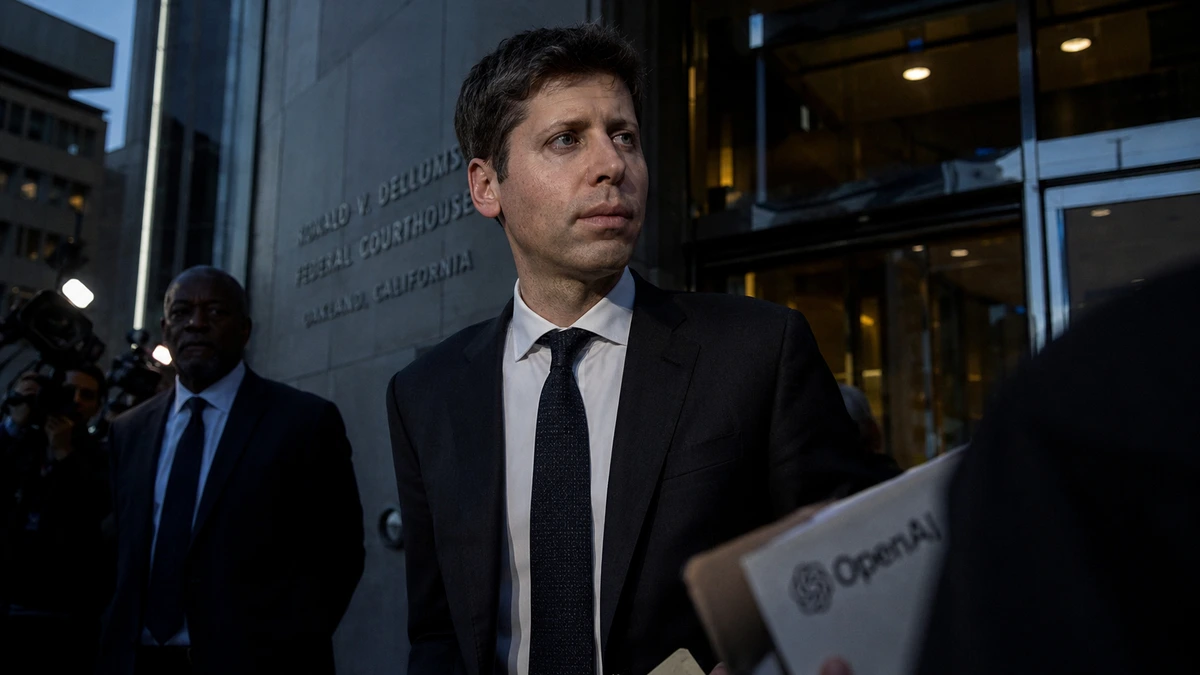
A court filing entered into evidence Tuesday in the Musk v. Altman trial put a precise number on something that had long been discussed in the abstract: OpenAI CEO Sam Altman holds more than $2 billion in personal stakes across nine companies that have active commercial ties to OpenAI. The Sam Altman conflict of interest OpenAI case is no longer a matter of speculation. It is now public record, in a federal courthouse in Oakland.
What the Court Filing Revealed
Musk’s lead trial lawyer, Steven Molo, presented a document listing Altman’s holdings in nine companies and their fair market value as of December 31, 2025. The biggest position is a roughly $1.7 billion stake in Helion Energy, the nuclear fusion startup that has signed an agreement to supply power to OpenAI’s future data centers. Altman owns approximately one-third of Helion and served as its board chairman until March 2026, when he stepped down as the two companies were negotiating a larger deal.
Also Read: Cisco Cuts 4,000 Jobs the Same Day It Reports Record AI Revenue
The list does not stop at Helion. Altman holds $633 million in Stripe, which has a financial services relationship with OpenAI, and $258 million in Retro Biosciences, a longevity pharma company that OpenAI’s compute resources support. Smaller positions span chipmaker Cerebras, which received a $10 billion compute contract from OpenAI, HR software company Lattice, AI hardware startup Humane, and biotech firm Formation Bio. In each case, the company has a commercial relationship with the AI lab Altman runs.
Altman does not hold direct equity in OpenAI. His estimated $4 billion net worth, according to Forbes, is built almost entirely from personal investments made before and during his tenure as CEO.
How Altman Explained It
On the stand, Altman said he recused himself from the key decisions in each case. On the Helion deal, he testified that he “was recused from it on both sides” and did not sign the agreement, even though he personally vouched for Helion to OpenAI’s board in late 2022 and described it as a good deal. On the Reddit content partnership, where he spearheaded negotiations, he said the board approved the final terms. On Cerebras, he acknowledged the $10 billion contract but noted his stake in that company was worth $3.2 million, not in the billions.
His defense rests on a specific definition of recusal: stepping out of the room for the final vote. Whether that is sufficient governance for the CEO of an $852 billion company directing hundreds of billions in contracts is the question that the trial has surfaced, and that regulators are now asking in parallel.
The Regulatory Pressure Building Outside the Courtroom
The trial has triggered action well beyond the jury box. Ten Republican state attorneys general wrote to the SEC this week asking it to scrutinize OpenAI’s documents ahead of the company’s anticipated IPO. Their letter stated that “Altman’s conduct to date raises serious legal questions and demands close scrutiny.” The SEC declined to comment.
The House Oversight and Government Reform Committee sent Altman a separate letter on May 8 requesting documentation on how OpenAI identifies and prevents conflicts of interest. The committee specifically cited the Helion relationship and the disclosure that OpenAI President Greg Brockman holds stakes in companies backed by Altman’s family fund.
This is the Sam Altman conflict of interest OpenAI story moving from a courtroom exhibit to a multi-front regulatory event in the span of a week.
What the Trial Outcome Could Mean
Closing arguments wrapped Thursday. The nine-person jury begins deliberations Monday. Their verdict is advisory only. Judge Yvonne Gonzalez Rogers makes the final call on liability, and she has indicated she would likely follow the jury’s recommendation.
Musk is seeking $150 billion in damages, removal of Altman and Brockman from OpenAI, and an unwinding of the company’s 2025 recapitalization. Even if Musk loses on the core claims, the conflict disclosures are now part of the public record and directly in the path of OpenAI’s IPO process.
The governance argument that OpenAI has operated with appropriate oversight is harder to make when a single court exhibit shows its CEO’s personal portfolio sits inside its own supply chain to the tune of $2 billion.
The Broader Question
OpenAI was founded as a nonprofit with a mission to develop AI for the benefit of humanity. The argument that Sam Altman could pursue that mission objectively while simultaneously holding $1.7 billion in a company whose commercial success depended on OpenAI’s energy contracts requires either extreme faith in human nature or a governance structure robust enough to compensate for it. The trial has shown that the second option was not in place.
Whether the jury finds legal liability or not, the Sam Altman conflict of interest OpenAI disclosure has done something the lawsuit itself may not: it has made the governance gap visible to regulators, investors, and the public at exactly the moment OpenAI is trying to go public.
