

Zoho founder Sridhar Vembu called AI “the biggest investment bubble yet” this weekend. He was careful to add that the technology is real. What he was reacting to is something Wall Street analysts have been quietly calling circular financing, and the numbers in SEC filings make it hard to dismiss.
What circular financing actually is
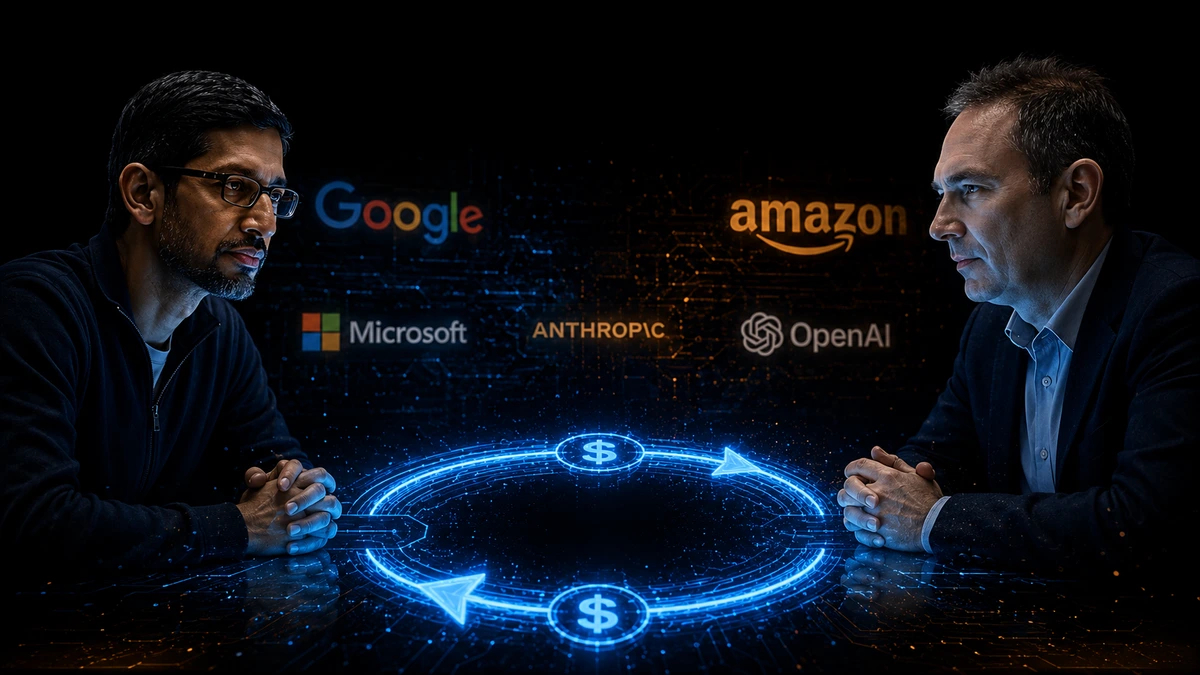
Circular financing is a deal structure where money flows between companies in a closed loop. A tech giant invests in an AI startup. The startup is contractually required to spend that investment back on the investor’s cloud infrastructure. The investor then records that compute spending as revenue from a paying customer. The same dollar gets recognized twice: once as an investment going out, and once as cloud revenue coming in.
The documented case is Microsoft and OpenAI. When Microsoft invested $13 billion into OpenAI, the funds came primarily as cloud credits rather than cash. OpenAI used those credits to train its models on Azure. Microsoft then recorded that usage as cloud revenue. One capital event produced two balance sheet entries.
Anthropic and Amazon run the same structure. Amazon committed $8 billion to Anthropic, and Anthropic agreed to use AWS as its primary cloud provider for training and running its AI models. The investment and the revenue flow from the same source.
Also Read: Anthropic Projects First Profitable Quarter With $10.9 Billion in Q2 Revenue
The numbers visible in SEC filings right now
The accounting consequences of this structure became undeniable in Q1 2026.
Nearly half of Alphabet’s record $62.6 billion quarterly profit, approximately $28.7 billion, did not come from search advertising, cloud services, or any Google product. It came from Alphabet updating the carrying value of its equity stake in Anthropic. The figure is confirmed in Alphabet’s own 10-Q filing: the net effect of a $36.9 billion equity securities gain increased net income by $28.7 billion in Q1 2026. No new customer was acquired. Anthropic raised a funding round, Alphabet marked up its stake, and the unrealized gain flowed directly into reported profit.
Amazon disclosed the same dynamic with equal directness in its Q1 2026 earnings release: net income for the quarter included pre-tax gains of $16.8 billion from investments in Anthropic. Amazon’s total net income was $30.3 billion. Strip out the Anthropic paper gain and the operational result looks substantially different. At the same time, Amazon’s free cash flow collapsed to $1.2 billion for the trailing twelve months, down from $25.9 billion the prior year, driven by a $59.3 billion increase in capital expenditures, primarily reflecting AI infrastructure investment.
Corporate filings show that OpenAI and Anthropic together account for more than half of the $2 trillion cloud backlog held by Microsoft, Oracle, Google, and Amazon. Oracle has 54% of its entire $553 billion pipeline dependent on a single customer: OpenAI.
Why this looks familiar
The structure has precedent. During the dot-com era, equipment vendors like Lucent and Cisco extended loans to telecom companies, and those same companies used the funds to buy equipment from Lucent and Cisco. The vendors recorded the sales as real revenue. When the underlying demand failed to materialize and the startups could not repay their loans, the vendors had to write down billions in revenue. Global Crossing went bankrupt. Qwest erased $1.4 billion in recognized income.
The critical difference today is legal and structural. The dot-com vendor financing schemes were often fraudulent. Today’s circular financing in AI is fully legal under current accounting rules. The 2016 FASB accounting standard update, which requires companies to mark private equity stakes to fair market value at each funding round, is the mechanism that converts Anthropic’s rising valuation directly into Alphabet’s and Amazon’s reported profit, without any cash changing hands between them and a paying customer.
That legality does not resolve the underlying question. If the revenue is real only because the investor is also the largest customer, and the customer’s valuation depends on the investor’s continued commitment, then the structural demand is not independent. It is engineered.
The distinction Vembu is making
Vembu’s framing is worth reading precisely. He did not say AI is useless or overbuilt. He said it is the biggest investment bubble yet, and then immediately clarified that the technology itself is real. His concern is the financial architecture surrounding a genuine technology, not the technology.
This is the same distinction worth holding on to now. AI is delivering measurable productivity gains. The models are improving. Enterprise adoption is genuine and growing. None of that is the issue.
The issue is whether the revenue figures being used to justify trillion-dollar valuations reflect organic demand from end users, or a structure in which the investor and the customer are the same entity, and the reported revenue evaporates the moment the investment cycle slows. Those are different underlying businesses, with different risk profiles, and the market is currently priced as though they are the same thing.
The question is not whether AI will matter in ten years. It is whether the companies priced for that future have built their financials on a foundation that survives independent scrutiny.
The number
$28.7 billion is the portion of Alphabet’s Q1 2026 record profit that came from a paper markup of its Anthropic stake, confirmed in Alphabet’s own SEC filing. Not from selling a product. Not from serving a customer. From updating a number on a spreadsheet.
