

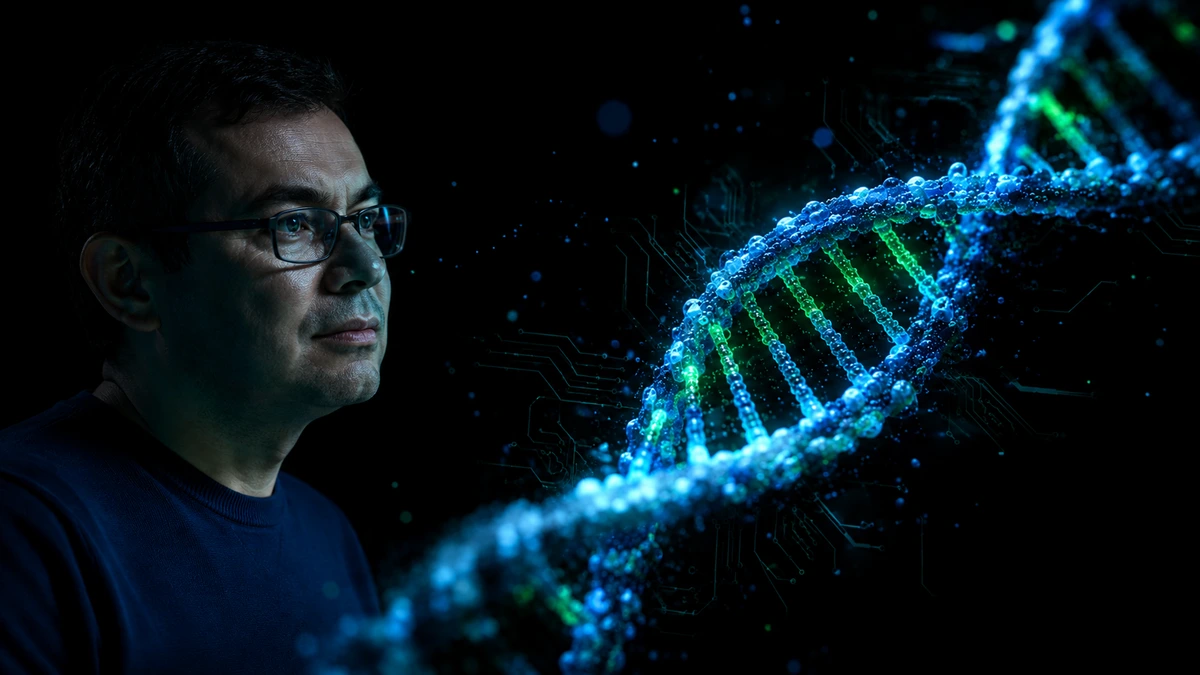
Demis Hassabis just raised $2.1 billion for his AI drug design company. The first human clinical trial has not happened yet. That tension is the entire story.
Isomorphic Labs, the London-based AI drug design company founded in 2021 as a Google DeepMind spinout, closed a $2.1 billion Series B on May 12, 2026. The round was led by Thrive Capital, which also led the company’s $600 million Series A in 2025. New investors include Abu Dhabi’s MGX, Singapore’s Temasek, and the UK Sovereign AI Fund. Alphabet, GV, and CapitalG participated again. Total capital raised now stands at approximately $2.6 billion.
The company’s platform, IsoDDE (Isomorphic Drug Design Engine), is built on the scientific foundation of AlphaFold, the protein structure prediction system that earned Hassabis and John Jumper the 2024 Nobel Prize in Chemistry. Where AlphaFold predicted how proteins fold, IsoDDE is designed to go further: identifying drug candidates, modeling protein-ligand interactions, and predicting binding affinity across multiple therapeutic areas in a single unified system.
What the $2.1 Billion Is For
Isomorphic Labs will use the capital to scale IsoDDE, expand its internal drug pipeline, and hire across AI research, engineering, drug design, and clinical functions at offices in London, Cambridge (Massachusetts), and Lausanne.
The company already has pharma partnerships in place. Eli Lilly signed in January 2024 for an upfront payment of $45 million with potential milestone value up to $1.7 billion. Novartis signed simultaneously for $37.5 million upfront and expanded the collaboration in February 2025. Johnson and Johnson joined in January 2026 in a multi-target, cross-modality research program.
That partnership base gives Isomorphic Labs something most AI biotech startups cannot claim: major drugmakers have committed real capital to the platform. That is not a letter of intent. That is operational integration.
Also Read: Mira Murati’s Thinking Machines Says Every AI Lab Built Interaction Wrong
The Isomorphic Labs $2.1 Billion Funding and the Missed Milestone
Here is what the press release does not lead with. At the World Economic Forum in Davos in January 2026, Hassabis revised the company’s clinical trial target. The original timeline called for the first AI-designed drug to enter human trials by end of 2025. That date passed without a patient being dosed. The revised target is end of 2026.
Hassabis later clarified he had been referring to pre-clinical trials in earlier statements. The distinction matters. Pre-clinical and clinical are categorically different stages. Pre-clinical work happens in labs and on animal models. Clinical trials involve human patients. No Isomorphic-designed compound has been administered to a human being.
That is the context behind the Isomorphic Labs $2.1 billion funding round. The company is raising at massive scale while its core proof point, a drug it designed entering a human body, remains in the future.
Why This Still Matters
The raise is not irrational. Drug discovery at scale requires enormous compute, deep expertise across biology and machine learning, and long development cycles that precede any clinical event. The investor roster, Thrive Capital returning as lead, sovereign wealth funds from the UAE and Singapore, and Alphabet doubling down, signals serious institutional conviction.
IsoDDE’s technical claims are also non-trivial. The company says its platform exceeds AlphaFold 3 on out-of-distribution biological benchmarks, meaning it performs better than its predecessor on biological targets that do not closely resemble its training data. That would be a meaningful advance if independently verified.
The open-source community has been building alternatives. Boltz-2 from MIT, Chai-1, and RoseTTAFold All-Atom now closely match AlphaFold 3 on standard benchmarks. But IsoDDE is a generation ahead of AlphaFold 3. The gap exists for now.
The Harder Question
The pattern in AI-driven drug discovery is familiar. Large raise. Bold mission framing. Partnerships with major pharma. And then the long, expensive, uncertain work of turning predictions into approved medicines.
Isomorphic Labs has shown the approach is technically credible. Investors with deep diligence capacity have reviewed the data and committed at scale. But $2.6 billion in total capital and a 2024 Nobel Prize do not shorten the FDA approval timeline.
The first clinical trial will be the real signal. Until then, the Isomorphic Labs $2.1 billion funding round is the largest vote of confidence in AI drug design ever recorded, placed on a bet that has not yet been resolved.
Watch for a clinical trial announcement from Isomorphic Labs before the end of 2026. That is the datapoint that changes everything.
