

Two years ago, the consensus on Wall Street and in Silicon Valley was straightforward: Google was toast. OpenAI had the models. Microsoft had the distribution. ChatGPT had the cultural moment. Alphabet, bloated and slow, was watching its core search business get eaten alive by something it had helped invent.
That story turned out to be wrong. Spectacularly wrong.
Alphabet stock is up approximately 160% over the past year. On May 8, 2026, the company hit an all-time high. For a brief moment in after-hours trading this week, it surpassed Nvidia to become the world’s most valuable company. The company everyone wrote off as the first casualty of the AI revolution is now being described by JPMorgan as its “top overall pick” in all of tech.
So what actually happened?
Google Didn’t Lose the AI Race. It Changed the Game.
The narrative in 2023 was about chatbots and language models. In that frame, Google was behind. Its Bard launch was embarrassing. Its AI Overviews served up misinformation. The company looked like it was playing catch-up on someone else’s terms.
What the narrative missed was that Google was never just competing on models. It was competing on the stack.
Gene Munster, managing partner at Deepwater Asset Management, put it plainly after last week’s Q1 earnings: “Google is one of the two best-positioned AI companies because they own most of the stack. Chips, models, infrastructure and distribution. On top of that, they’re nicely profitable.”
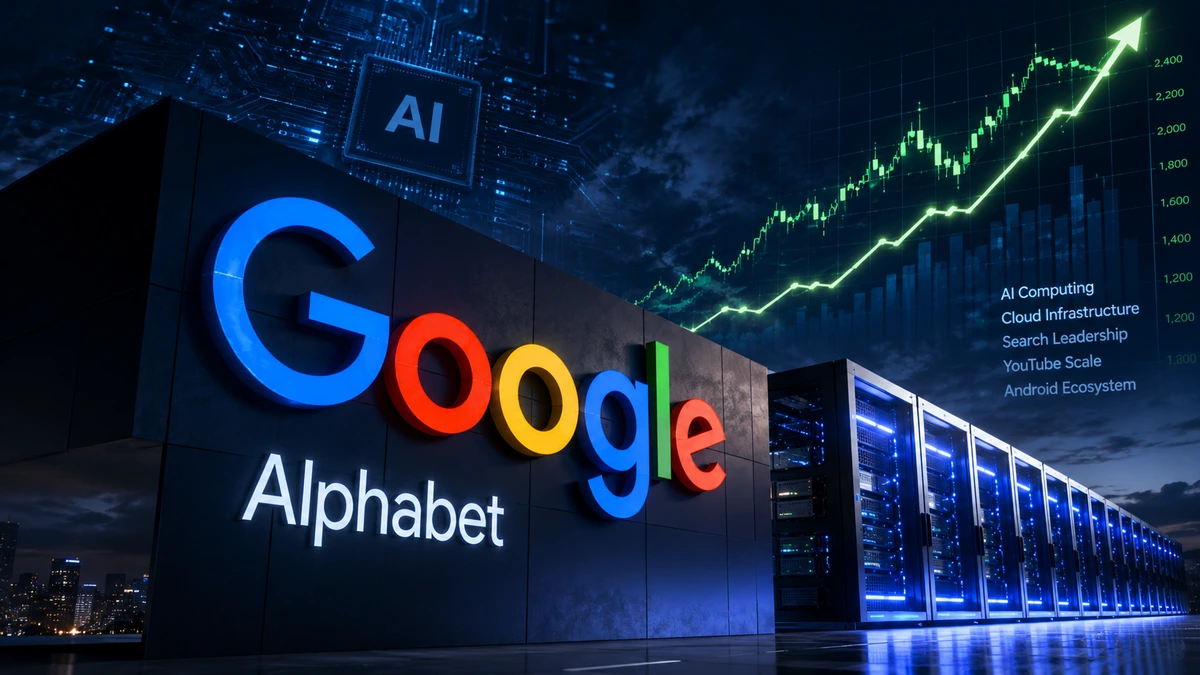
That stack includes Gemini for frontier AI models, custom Tensor Processing Units (TPUs) as an alternative to Nvidia’s GPUs, Google Cloud for enterprise compute, and Google Search, YouTube, and Android as distribution channels that touch billions of users daily. No other company outside of a speculative case for Microsoft can claim all four layers simultaneously.
The Q1 2026 numbers reflect exactly this. Google Cloud revenue surged 63% year over year to $20 billion, crossing that threshold for the first time in the company’s history. Cloud operating income more than doubled. The contracted backlog nearly doubled sequentially to $462 billion, with over half expected to convert to revenue within the next 24 months. Search revenue grew 19%. Net income for the quarter hit $62.6 billion, up 81% year over year.
These are not the numbers of a company that lost.
Also Read: The AI Browser War. Where is Google?
The Tension the Market Is Not Fully Pricing In
Here is where the story gets more interesting than a simple vindication narrative.
A significant portion of that $462 billion cloud backlog traces back to a single customer. Anthropic, the AI company behind the Claude model family, has reportedly committed to spending $200 billion on Google Cloud over five years. If accurate, that commitment represents more than 40% of Alphabet’s entire contracted cloud revenue.
Google is simultaneously one of Anthropic’s largest investors and its largest infrastructure customer. The capital flows in a circle: Google invests in Anthropic, Anthropic uses that capital to pay Google for cloud compute, and Google books it as backlog growth. Analyst Gil Luria at D.A. Davidson described it bluntly: “They did it the same way Oracle did. They told us their backlog roughly doubled without telling us that almost the entire increase came from one deal with Anthropic.”
This is not necessarily a scandal. It may simply be how the AI economy works at scale. But it does mean that Google’s cloud growth story is, in part, a story about the circular economics of AI funding rather than pure organic enterprise demand. If Anthropic stumbles, raises less capital, or shifts infrastructure providers, Google’s backlog takes a meaningful hit.
What This Means for the AI Industry
The broader lesson here is about what the AI race actually rewarded. It did not reward whoever shipped the most impressive demo in 2023. It rewarded whoever controlled the underlying infrastructure at scale, had the balance sheet to sustain a multi-year capital investment cycle, and had existing products through which to distribute AI at zero marginal cost.
Google had all three. The threat from OpenAI, paradoxically, accelerated Google’s internal transformation rather than defeating it. Sundar Pichai noted on the Q1 earnings call that the company’s AI investments and “full-stack approach” are driving performance across every business line, with first-party models now processing more than 16 billion tokens per minute via direct API access, up from 10 billion the previous quarter.
Alphabet is also spending aggressively to protect this position. Full-year 2026 capital expenditure guidance stands at $180 billion to $190 billion, an extraordinary figure that reflects both the scale of infrastructure demand and the company’s confidence in its ability to convert that demand into revenue.
The company that was supposed to be disrupted by AI now sits at the center of the AI economy. The question worth asking is not whether Google won. It is whether that level of stack dominance is good for the industry that feeds off it.
