

Every major AI lab is racing to ship a personal agent. OpenAI has its ChatGPT Agent. Anthropic has Claude Cowork. And now Google has Gemini Spark, announced at Google I/O 2026 on May 19. But Spark is not just another entrant in an already crowded field. It is the first agent that arrives pre-loaded with the most comprehensive view of your digital life that any company on earth has ever assembled.
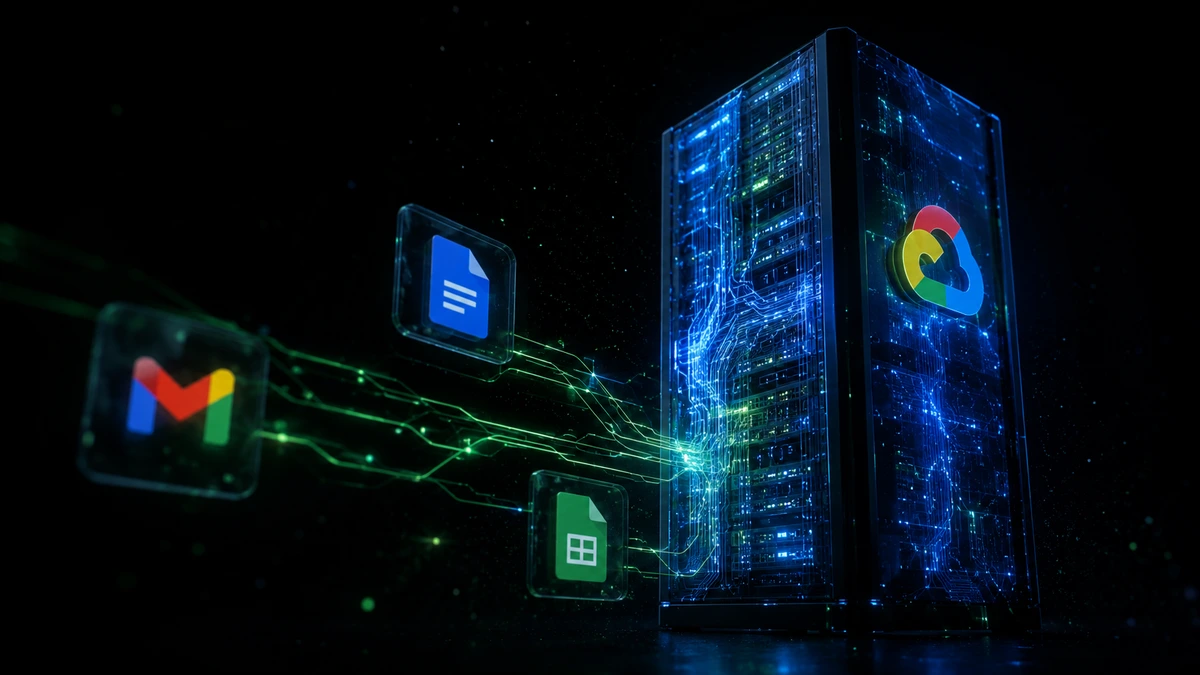
The Google Gemini Spark AI agent runs on dedicated virtual machines on Google Cloud, which means it keeps executing tasks even when your laptop is closed and your phone is in your pocket. Alphabet CEO Sundar Pichai described it plainly in his keynote: “It’s your personal AI agent that helps you navigate your digital life, taking action on your behalf and under your direction. It runs on dedicated virtual machines on Google Cloud seamlessly, so you don’t need to keep your laptop open to make sure it’s running.”
What Gemini Spark Actually Does
The Google Gemini Spark AI agent integrates natively with Gmail, Google Docs, Sheets, Slides, and Chrome without requiring any manual setup or third-party permissions. When the rollout to Google AI Ultra subscribers begins, users will be able to delegate tasks by emailing Spark through a dedicated Gmail address, the way you would message a human colleague. The agent reads your inbox context, pulls relevant data from your documents, drafts communications, manages follow-ups, and surfs the web through Chrome on your behalf.
On mobile, progress updates surface through Android Halo, a new notification layer built into Android’s status bar.
Josh Woodward, VP of the Gemini App and AI Studio at Google Labs, illustrated the use case during the I/O demo: “Need to send an email to your boss with a status update? Spark can pull all the facts from your emails, your docs, your sheets, and slides and write the draft for you. Small businesses are using Spark. They can watch over their inbox, so they never miss a question from a customer.”
Spark is built on Gemini base models and the Google Antigravity agentic harness. It also supports the Model Context Protocol, meaning it can connect to external services beyond the Google ecosystem. Google expects to roll out additional integrations in the months ahead. The agent is currently in testing and will be available to Google AI Ultra subscribers in the week following the I/O announcement.
Also Read: Andrej Karpathy Joins Anthropic Pre-Training Team
The Real Story Is the Data Moat
Competing agents from Anthropic and OpenAI can plug into Gmail and Google Workspace through third-party integrations. But those connections require setup, permissions, and ongoing maintenance. Spark arrives with all of that pre-wired because Google built the infrastructure the agent runs on.
That structural advantage is not a product feature. It is a business model. Google has spent two decades accumulating the most detailed record of how knowledge workers communicate, organize information, and get things done. Spark converts that record into the agent’s operating context. No competitor can replicate that without Google’s cooperation, and Google has no reason to cooperate.
This is the same logic that made Google Search difficult to displace: not because the search algorithm was unbeatable, but because the index was unreachable. The agent race is beginning to look similar.
Gemini Omni Enters the Picture
Google IO 2026 was not only about agents. The company also announced Gemini Omni, a new multimodal model family designed to generate and edit video from any combination of text, image, audio, and video inputs. It positions itself as a step beyond the standalone Veo line, embedding video generation directly inside the core Gemini system.
The first model in the family, Gemini Omni Flash, began rolling out on May 19 to Google AI Plus, Pro, and Ultra subscribers through the Gemini app and Google Flow, and to YouTube Shorts at no cost. The current release generates clips up to 10 seconds in length. Google DeepMind CEO Demis Hassabis described the model as offering a stronger intuitive grasp of physics, gravity, and kinetic motion compared to prior models. The eventual roadmap is a single model that can handle any input and produce any output, though video is the starting point.
Omni is secondary to Spark in terms of structural significance, but it signals that Google is collapsing its media generation stack into one unified system rather than maintaining a growing collection of named models.
The Numbers Behind the Shift
At the keynote, Pichai confirmed that the Gemini app had grown from 400 million monthly active users at I/O 2025 to over 900 million at I/O 2026, more than doubling in a year, with daily requests growing over seven times in the same period. Google is planning capital expenditure of between $180 billion and $190 billion in 2026, a figure that reflects how seriously it is treating the infrastructure buildout required to run agents at scale.
What This Means for Anyone Building in AI
The shift from chatbot to agent is not a product category update. It is a distribution strategy. Whoever controls the agent that sits in the background of a user’s working day controls the default layer of AI. Google is betting that the path to that default position runs through Gmail, and it has a stronger claim to that starting point than any rival.
The question now is not whether agents are coming. It is which agent gets to be the one you forget is running.
