

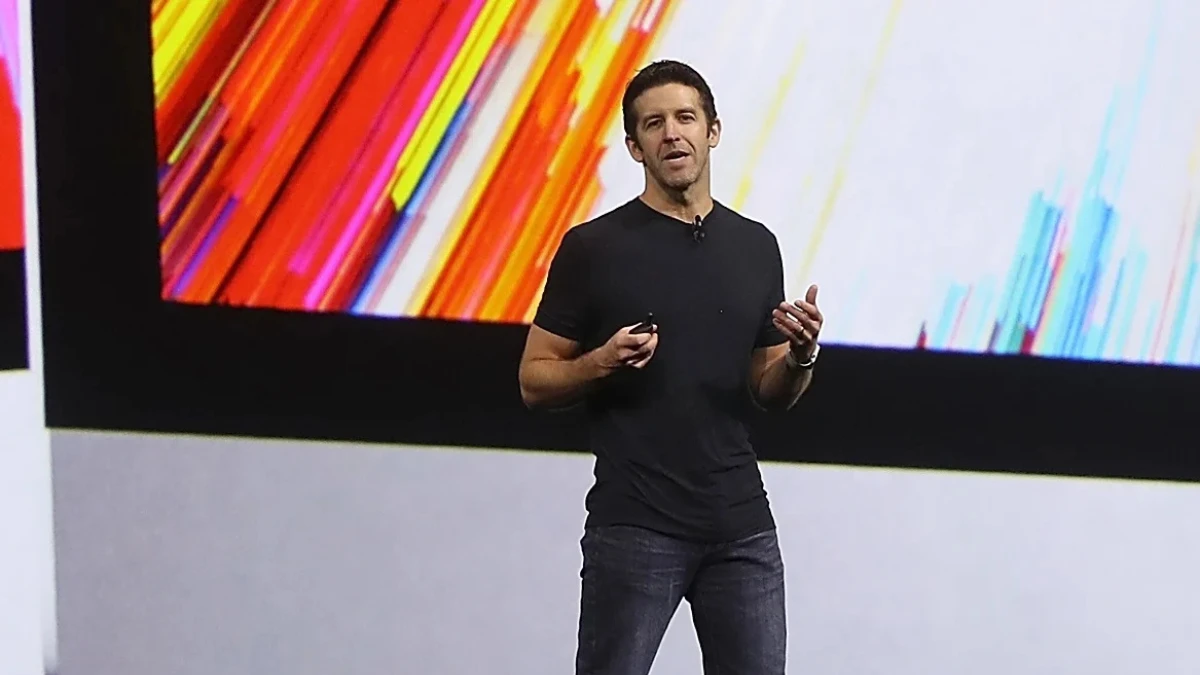
Tim Cook steps down as Apple CEO effective September 1, 2026, ending a 15-year run that turned Apple into a $4 trillion company and one of the most operationally efficient businesses in history. John Ternus, Apple’s SVP of Hardware Engineering, will take over as CEO. Cook will remain with the company as executive chairman.
The numbers Cook leaves behind are staggering. Apple’s market cap grew from approximately $350 billion to $4 trillion under his tenure, a more than 1,000% increase. Annual revenue nearly quadrupled from $108 billion in fiscal 2011 to $416 billion in fiscal 2025. Apple’s stock delivered a 1,886% return over that same period, compared to 483% for the S&P 500. Services revenue alone grew from roughly $12.9 billion to $85.2 billion — a business that now operates at 75% margins.
But Tim Cook steps down as Apple CEO at a moment of real strategic uncertainty. Apple Intelligence, the company’s flagship AI initiative announced at WWDC 2024, has underdelivered. The promised AI-supercharged version of Siri, capable of deep app integration and personal context awareness, was delayed out of 2025 entirely and pushed to 2026. Apple disabled its AI notification summaries for news apps after the feature generated fabricated headlines. John Giannandrea, Apple’s AI and machine learning chief, announced his departure. The company is now reportedly preparing to power Siri using Google’s Gemini models, a striking admission from a company that has spent a decade building its own silicon precisely to avoid such dependencies.
Who Is John Ternus?
John Ternus Apple CEO succession has been widely anticipated. Ternus, 50, has spent 25 years at Apple. He joined in 2001 as a mechanical engineer on the product design team and rose through hardware leadership to become SVP of Hardware Engineering in 2021. His team is responsible for iPhone, Mac, iPad, AirPods, Apple Watch, and Apple Vision Pro. He led the transition to Apple Silicon, arguably the most significant platform shift Apple made under Cook, and oversaw the MacBook Neo and iPhone 17 lineup.
What Ternus is not is a software executive, an AI researcher, or a services strategist. He is a hardware engineer. The board’s decision to appoint him is a signal about where Apple believes the competitive battle will actually be won.
Also Read: AI Now Generates More Internet Content Than Humans
The Hardware Bet
Apple’s AI strategy 2026 under Ternus will almost certainly center on devices as the AI interface. Apple has 2.5 billion active devices globally — a distribution advantage no AI lab, not OpenAI, not Google, not Anthropic, can replicate. Forrester analyst Dipanjan Chatterjee framed the Ternus appointment directly: a hardware leader signals that Apple will seek differentiation in its physical products, reframing the device itself as the substrate for intelligent experiences.
If that bet is right, Ternus is exactly the right person. A foldable iPhone is expected to launch shortly after he takes over. Rumored smart glasses are in development. The next hardware cycle could become the AI interface cycle, where the device form factor matters as much as the model behind it.
The risk is that the software and model gap widens faster than the hardware cycle can close it. OpenAI is building its own AI-first device. Google Gemini is already deeply embedded across Android. Microsoft Copilot is in every enterprise workflow. Apple’s moat is distribution, not capability, and distribution advantages erode when users start reaching for a competitor’s app on their own iPhone.
What Cook Leaves Behind
Apple market cap $4 trillion is Cook’s most visible legacy, but the operational infrastructure underneath it is equally significant. He built Apple’s services business from near zero to a Fortune 40-equivalent revenue line. He oversaw the AirPods and Apple Watch categories, both of which became the dominant products in their segments globally. He navigated tariff wars, supply chain disruptions, and a global pandemic without a single year of revenue decline.
The AI chapter is the exception. Cook had the resources, the silicon, and the installed base to lead in AI. The window was open from 2022 onward. Apple chose caution, on-device processing, privacy-first architecture, deliberate rollouts, while the rest of the industry moved at a speed that made caution look like paralysis.
Ternus inherits a company with extraordinary fundamentals and a genuine capability gap in the most important technology cycle of the decade. Whether a hardware engineer can close a software gap is the question that will define his tenure.
