


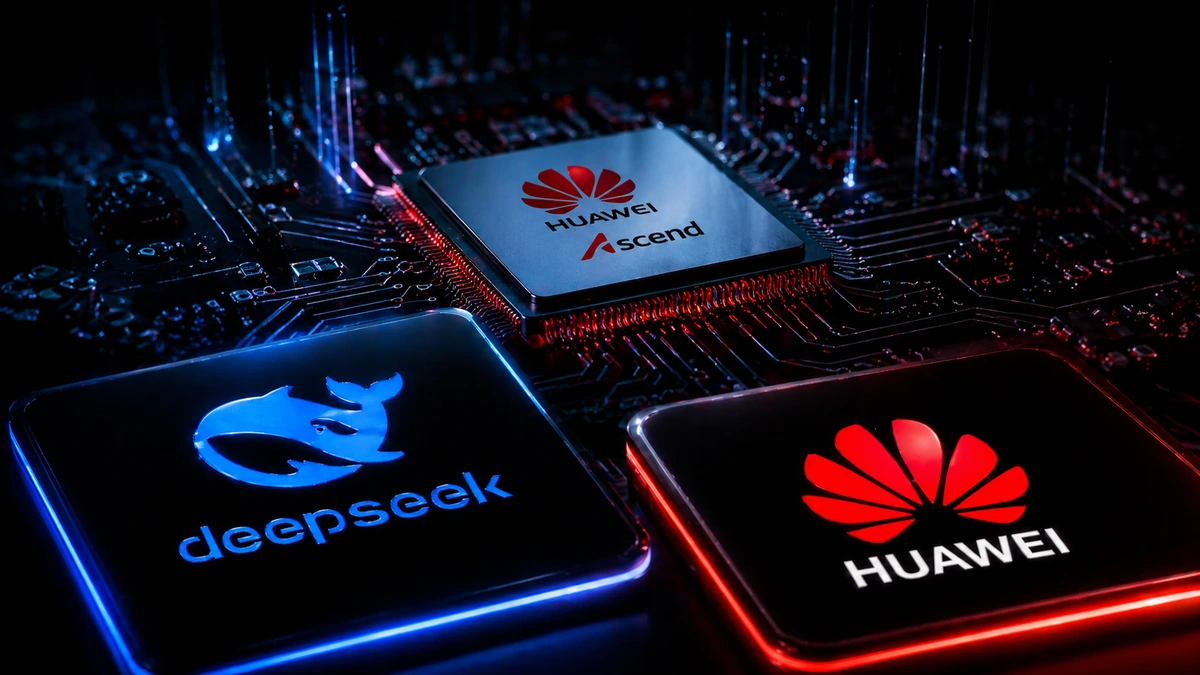
On April 24, 2026, Chinese AI lab DeepSeek released V4, its most capable model to date, and handed exclusive early optimization access to Huawei and other Chinese chipmakers. NVIDIA and AMD were shut out. For anyone tracking the US-China AI race, this is the moment the export control strategy began to crack in public.
What DeepSeek V4 Actually Is
DeepSeek V4 launches in two variants: V4-Pro, a 1.6 trillion-parameter Mixture-of-Experts model with 49 billion active parameters per token, and V4-Flash, a leaner 284 billion-parameter version built for speed and cost efficiency. Both support a one million token context window. V4-Pro is priced at $1.74 per million input tokens and $3.48 per million output tokens. OpenAI’s GPT-5.5 costs $5 input and $30 output. That is roughly a 10x pricing gap at the frontier.
Both models are open-source, available on Hugging Face and through the DeepSeek API. Developers can download the weights and run them locally.
The Hardware Signal Is the Real Story
DeepSeek V4 is the first frontier-class model built with deep optimization for Huawei’s Ascend 950 chips. When V4 was in development, DeepSeek gave Chinese chipmakers early access: the kind of pre-release collaboration that allows hardware teams to optimize drivers, compilers, and inference stacks ahead of launch. Nvidia and AMD did not receive that access.
On launch day, Huawei confirmed its Ascend 950 supernode infrastructure provides full support for DeepSeek V4. Shares of SMIC, the Chinese foundry that manufactures Huawei’s Ascend chips, jumped 10% in Hong Kong trading.
DeepSeek expects to lower V4-Pro API prices further once Huawei scales Ascend 950 production in the second half of 2026. Cheaper Chinese chips will mean cheaper Chinese AI inference. The trajectory is clear.
Jensen Huang’s Warning, Now Materializing
At NVIDIA’s GTC conference in March 2026, Jensen Huang made his position explicit: “There’s no question we need to have American tech stack in China.” His reasoning has been consistent for years. Pushing China outside the American hardware ecosystem does not eliminate Chinese AI capability. It accelerates the development of an alternative ecosystem.
In a mid-April podcast with Dwarkesh Patel, Huang debated the national security implications of chip exports directly. Critics argue his position is self-serving, given NVIDIA’s significant commercial interest in the Chinese market. That criticism is fair. But the underlying argument is also proving out in real time. China did not slow down. It built differently.
What Export Controls Actually Did
The US bet was that restricting access to advanced Nvidia GPUs would limit China’s AI compute ceiling. DeepSeek has now published three consecutive model generations, V3, R1, and V4, each competitive at the frontier, each developed under those restrictions. The constraint that was supposed to create a gap instead created pressure that drove efficiency innovation.
DeepSeek also faces a separate set of accusations. Anthropic and OpenAI have both accused the company of conducting industrial-scale distillation attacks, training their models on outputs from US frontier models to extract capabilities. China’s foreign ministry called the claims “groundless.” Those accusations remain unresolved and contested, adding a further layer to what is already a deeply adversarial technology relationship.
The Stakes
If Huawei’s Ascend roadmap delivers, with the 960 and 970 chips targeting roughly double the performance gains over each generation, China could have a fully sovereign AI infrastructure stack within two to three years. Frontier-class models, trained and deployed on domestic chips, priced at a fraction of US alternatives, distributed as open weights to the world.
That is not a hypothetical. With DeepSeek V4, it is already partially true.
Washington used chip controls as its primary tool in the AI race. That tool just got noticeably less sharp.
