

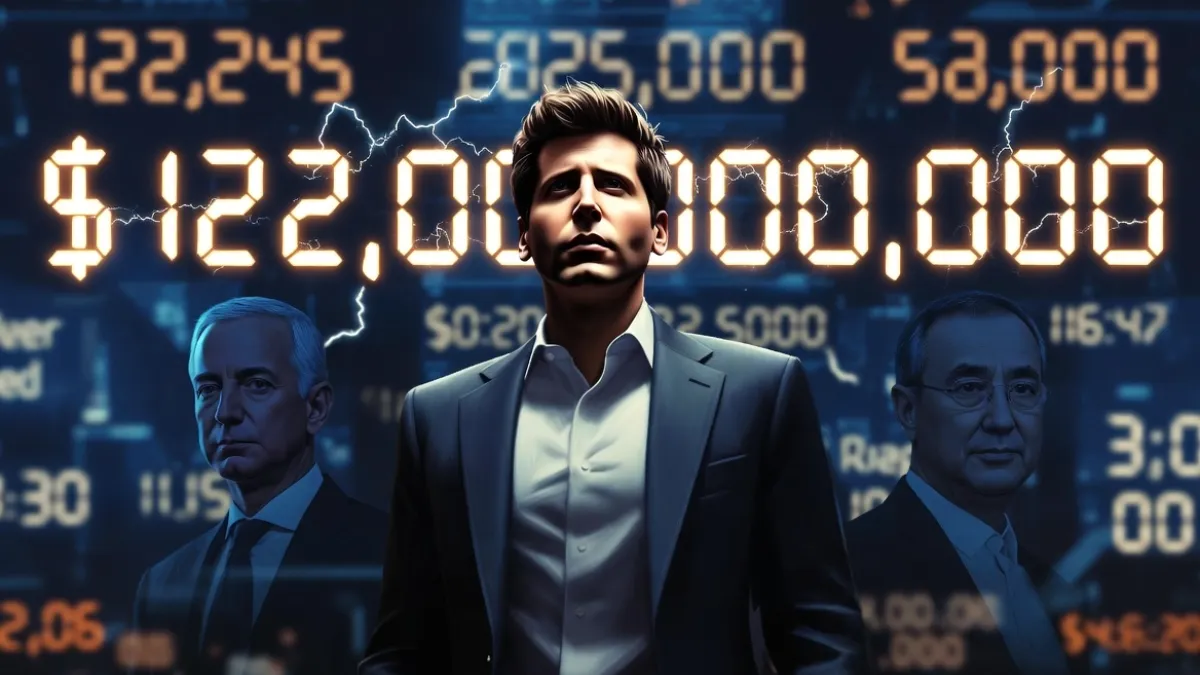
OpenAI just made history. The company behind ChatGPT closed a $122 billion funding round at an $852 billion post-money valuation — the largest private fundraise in the history of technology. Not by a little. By a margin that makes every previous record look modest.
The round was anchored by three strategic investors: Amazon committed $50 billion, Nvidia and SoftBank each put in $30 billion, and Microsoft participated again, though the size of its contribution was not disclosed. A broader group of institutional investors — including Andreessen Horowitz, D.E. Shaw Ventures, Sequoia, BlackRock, and Abu Dhabi’s MGX — rounded out the deal. For the first time in OpenAI’s history, individual investors were also allowed to participate through bank channels, contributing approximately $3 billion of the total.
The company says it now generates $2 billion in monthly revenue, serves over 900 million weekly active users on ChatGPT, and counts enterprise customers as more than 40% of its revenue — a figure expected to reach parity with consumer revenue by the end of 2026.
On paper, it is an extraordinary story of growth. Underneath the headline, the picture is considerably more complicated.
The $122 Billion Is Not What It Appears
Strip away the headline number and examine the structure of the commitments, and a different story emerges.
Amazon’s $50 billion is not arriving all at once. Only $15 billion was paid upfront. The remaining $35 billion is contingent — it only flows to OpenAI if the company completes an IPO or achieves a defined artificial general intelligence milestone by the end of 2028. Neither outcome is guaranteed, and the milestone definition itself remains redacted in SEC filings.
Nvidia’s $30 billion contribution is not cash at all. It is dedicated GPU compute capacity — hardware infrastructure commitments that OpenAI can use to train and run its models. You cannot pay salaries or cover operating expenses with GPUs.
SoftBank’s $30 billion is structured in installments — three tranches of $10 billion each, arriving in April, July, and October 2026. The phased structure is deliberate. It gives SoftBank the ability to evaluate OpenAI’s progress before deploying the full amount.
Add it up and the actual immediate liquidity OpenAI received from this record-breaking round is approximately $25 billion — $15 billion from Amazon and the first $10 billion tranche from SoftBank.
The Burn Rate Is the Real Story
That $25 billion in real cash lands against a brutal cost structure. OpenAI is projected to lose $14 billion in 2026 alone. Losses are expected to escalate to $35 billion by 2027 and $45 billion by 2028 as infrastructure spending compounds. The company’s server costs alone are projected to reach $665 billion through 2030 — against revenue forecasts of $284 billion over the same period.
OpenAI does not expect to reach profitability until 2030 at the earliest.
In practical terms, this round does not give OpenAI a multi-year war chest. It gives the company a window — roughly 18 to 24 months — to either reach sustainable unit economics, execute an IPO, or return to investors for another round. Given that trajectory, the IPO is not optional. It is inevitable.
What This Means
OpenAI CFO Sarah Friar described the financing as something that “blows out of the water even the largest IPO that’s ever been done.” That framing is telling. The company is already thinking in IPO terms — because it has to.
The $852 billion valuation places OpenAI above Visa, JPMorgan Chase, and Samsung. It is a company that has never turned a profit, burning through capital at a rate that requires perpetual fundraising, valued on the assumption that everything goes right — the models keep improving, the enterprise customers keep coming, the IPO happens on schedule, and AGI remains a useful enough concept to keep investors committed.
Maybe it all works out. The history of technology suggests that companies with this kind of momentum sometimes do justify their valuations and then some.
But the $122 billion headline deserves a closer read than most coverage has given it. The number is real. The cash is not — at least not yet.
