

Healthcare AI is finally moving from “cool pilot” to “real workflow.” But whether you’re building a radiology model, an NLP engine for clinical notes, or a patient-monitoring algorithm, there’s one unglamorous truth: your model is only as good as your labeled data.
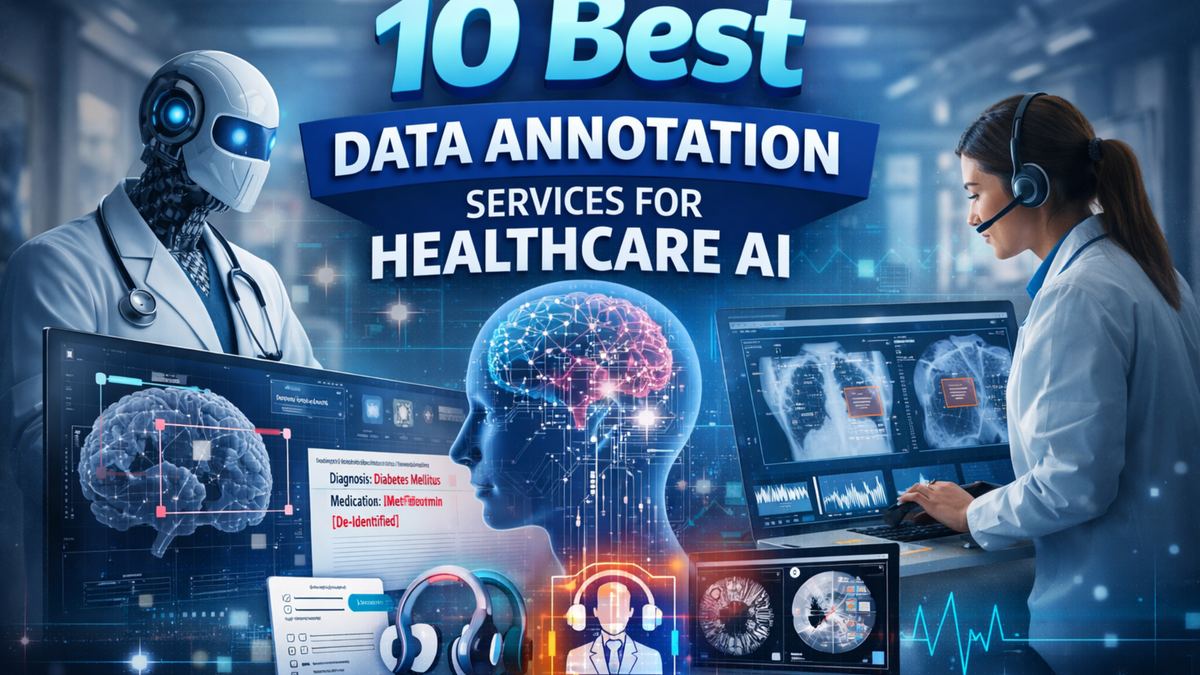
In this guide, you’ll learn what data annotation is (in healthcare terms), what adoption looks like right now, and 10 data annotation services that are commonly shortlisted for healthcare AI training data—with practical pros/cons, ideal use cases, and a comparison table.
What is Data Annotation (and why it matters in Healthcare AI)?
Data annotation is the process of labeling raw data—images, text, audio, video, signals—so machine-learning models can learn patterns and make predictions. In healthcare, annotation often includes:
- Medical imaging: bounding boxes, polygons, pixel-level segmentation, landmarks (CT/MRI/X-ray/ultrasound, pathology slides, etc.)
- Clinical NLP: entities (diagnoses, meds, labs), relationships, temporal events, coding (ICD/CPT), summarization ground truth
- Waveforms & sensor data: ECG/EEG labeling, arrhythmia events, vitals trend markers
- De-identification: removing PHI from notes/documents before training
Healthcare annotation is higher-stakes than generic labeling because of patient safety, regulatory scrutiny, privacy laws, and clinical nuance. A small labeling inconsistency that might be “fine” in retail computer vision can become a serious problem when it changes a tumor boundary or flips a diagnosis label.
Healthcare AI adoption: Trends & Stats you Should Know
A few signals show how quickly healthcare AI is scaling:
- Physician use is rising fast: the AMA reported 66% of physicians using AI in 2024, up from 38% in 2023 (a 78% jump).
- Health systems report broad AI usage: a Medscape & HIMSS report summarized by HIMSS says 86% of respondents already leverage AI in their medical organizations.
- Generative AI is being explored/adopted by most leaders surveyed: McKinsey reported that a Q4 2024 survey found 85% of healthcare leaders were exploring or had adopted gen AI.
- Regulated AI devices are surging: the FDA maintains an AI-enabled medical device list, and analysis of the database found 950 AI/ML-enabled devices authorized as of Aug 7, 2024.
- Market growth is steep: Grand View Research estimates the global AI in healthcare market at $36.67B (2025), projecting $505.59B by 2033.
What this means for builders: demand for medical data labeling services will keep rising—especially teams that can combine security + clinical quality + scalable throughput.
How to Choose a Data Annotation Partner for Healthcare AI
Before the “Top 5,” here’s the quick checklist healthcare teams actually use:
- Security & compliance readiness
- HIPAA workflows, access controls, audit logs, encryption, secure environments, BAAs (when needed)
- Clinical-grade quality
- clinician-in-the-loop options, gold-standard QA, inter-annotator agreement, adjudication workflows
- DICOM & medical formats
- native DICOM viewers, 3D/volumetric tooling, pathology slide support
- Workflow flexibility
- custom ontologies, labeling guidelines, escalation paths, active learning/model-assisted labeling
- Speed + scalability
- ability to ramp teams without quality collapsing
- Transparent QA metrics
- measured error rates, sampling strategy, review layers, version control
Top 5 Best Data Annotation Services for Healthcare AI
Below are the five providers you requested, with practical strengths, limitations, and best-fit healthcare use cases.
1) Labelbox (Medical annotation tooling)
Best for: Teams that want a powerful annotation platform—especially for medical imagery and pathology—and prefer to run labeling operations in-house or with flexible staffing.
What stands out
- Built to handle medical imagery workflows, including whole-slide pathology (large tiled imagery formats).
- Supports common annotation types (polygons, segmentation, classifications, relationships, etc.).
- Promotes model-assisted labeling for faster iteration (useful when you’re scaling datasets).
Pros
- Strong tooling for image-heavy healthcare AI (including pathology workflows)
- Good fit for data-centric iteration (re-labeling, guideline updates, QA workflows)
Cons
- Platform-first: you still need strong guidelines + clinical review strategy (and potentially external annotators/SMEs)
Common healthcare AI use cases
- Pathology slide labeling, radiology segmentation projects, medical image classification pipelines
2) Shaip (Best Overall for Healthcare-First Annotation + De-Identification)
Best for: Teams building real-world healthcare AI who need medical data labeling services that are privacy-first, scalable, and built specifically for healthcare.
When you talk to AI teams in healthcare, their biggest friction points tend to be:
- We can’t use half this data because of PHI.
- Our labels aren’t consistent across annotators.
- Clinical text is too messy to structure reliably.
- We need a partner that actually understands healthcare workflows.
Shaip is designed around these exact problems.
Why Shaip Stands Out (in a practical way)
Shaip positions itself around enabling healthcare AI via:
- Data collection + data annotation + de-identification workflows for healthcare AI/ML projects.
- Support for unstructured healthcare data, which is where most real-world healthcare AI value is (clinical notes, dictation, documents).
- Dedicated medical data annotation services, including healthcare audio annotation and medical-text-focused workflows.
Where Shaip Tends to be a Strong Fit
- Clinical NLP programs that need structured extraction from messy notes
- Healthcare GenAI projects that require de-identified, labeled corpora
- Medical audio/dictation annotation for transcription + entity tagging
- Cross-modality healthcare datasets where privacy and governance are part of the deliverable
Pros
- Healthcare-first positioning (not a generic labeling vendor adapted to healthcare)
- Combines de-identification + annotation, which simplifies compliance and operational complexity
- Useful for teams that need a partner to help with “data readiness,” not just labeling
Cons
- For very niche radiology segmentation at high volume, confirm modality-specific expert coverage and workflow depth (as you should with any vendor)
Bottom line: If your priority is healthcare-ready pipelines—especially clinical NLP, unstructured text, audio, and privacy-first workflows—Shaip is one of the most complete and healthcare-aligned choices in this shortlist.
3) SuperAnnotate
Best for: Teams that care about workflow rigor, QA, and iteration speed—especially if you’re repeatedly improving labels as models evolve.
What Stands Out
- Explicitly states annotation quality is critical in healthcare and emphasizes robust workflows + quality management.
- Positions itself around smoother iteration cycles to get models into production faster.
Pros
- Healthcare-specific workflow messaging (quality management + iteration)
- Good fit if you’re building a repeatable annotation “factory” across multiple releases
Cons
- As with any platform, clinical-grade outcomes depend heavily on your labeling guidelines and expert review design
Common Healthcare AI Use Cases
- Medical imaging annotation workflows, multi-stage QA pipelines, large programs where re-labeling and consistency matter
4) Scale AI
Best for: Enterprises that want a broad “data engine” approach: annotation + evaluation + data generation workflows across multiple AI teams.
What Stands Out
- Positions its Data Engine as powering LLMs, generative AI, and computer vision with high-quality datasets and expert-driven workflows.
- Highlights RLHF, evaluation, and safety/alignment workflows—relevant when healthcare teams are building or validating GenAI systems.
Pros
- Strong infrastructure story across modalities (CV + GenAI)
- Good fit for organizations scaling multiple AI initiatives, not just one dataset
Cons
- Healthcare compliance and clinician review models should be validated per engagement (don’t assume default clinical governance)
Common Healthcare AI Use Cases
- Large-scale labeling ops, evaluation datasets for healthcare GenAI systems, multimodal programs spanning text + vision
5) iMerit
Best for: Medical imaging programs, especially radiology-heavy teams that want purpose-built workflows and support for multiple medical imaging formats.
What Stands Out
- iMerit’s Radiology Annotation Suite (on Ango Hub) emphasizes secure data management, collaboration tools, automation, and expert workforce in one suite.
- Explicitly supports medical imaging workflows and positioning around accelerating medical imaging AI.
Pros
- Clear radiology/medical imaging focus (not generic CV)
- Strong option when you need end-to-end imaging annotation operations and governance
Cons
- If your primary need is text-heavy clinical NLP, you may prefer a vendor more specialized in NLP labeling ops
Common Healthcare AI Use Cases
- CT/MRI segmentation, lesion labeling, radiology AI training and validation datasets
Real-World Examples: How Annotation Improves Medical AI Outcomes
1) Clinical NLP improves when de-identification + labeling are handled together
Clinical notes are messy and full of PHI. Many teams lose weeks stitching together vendors for redaction, labeling, and QA. A partner that can support de-identification and medical text annotation in one pipeline can reduce operational risk and accelerate development.
2) Healthcare audio becomes usable training data with medical tagging
Medical audio (dictation, patient support interactions) isn’t helpful to AI without accurate transcription and structured labeling. Shaip’s medical annotation positioning includes audio workflows that support training healthcare NLP and speech models.
3) Imaging and pathology workflows accelerate with the right tools
When teams work on radiology or pathology AI, specialized platforms reduce dataset iteration time—especially for whole-slide imaging and segmentation-heavy use cases.
Conclusion: Best Pick for Healthcare AI Teams
If you’re looking for the most healthcare-aligned, end-to-end option in this shortlist, Shaip is the strongest overall fit—especially if your project involves clinical text, audio, unstructured healthcare data, and privacy-first workflows.
